

What's Happening?
Abby Vieregg, a professor of physics and astronomy and astrophysics at the University of Chicago, is dedicated to detecting high-energy neutrinos, often called 'ghost particles,' to understand the most energetic places in the universe. Neutrinos are fundamental
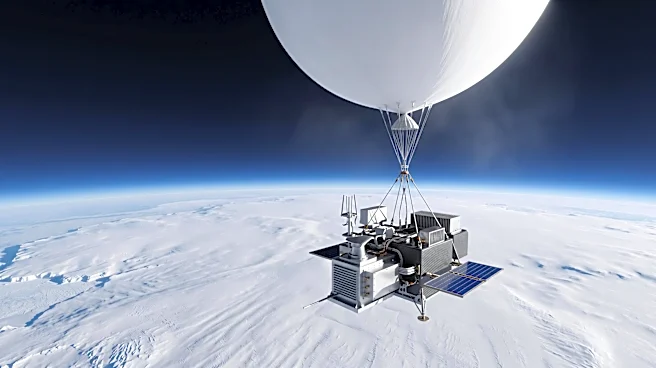
particles that can travel vast cosmic distances without interacting, making them ideal messengers from distant, powerful cosmic engines. However, their non-interactive nature makes them incredibly difficult to detect. Vieregg's team utilizes massive detectors, including the entire Antarctic continent, to catch rare interactions. Her NASA balloon mission, PUEO (Payload for Ultra-High Energy Observations), flies 40 kilometers above the Antarctic ice sheet, using it as a detector to observe radio signals from neutrino interactions. This method relies on the Askaryan effect, where high-energy particles create a shower that emits coherent radio waves as they move faster than the speed of light in the ice. Vieregg also works on the RNO-G (Radio Neutrino Observatory in Greenland) experiment, which places arrays of antennas directly in the ice to detect lower-energy neutrinos, complementing PUEO's high-energy focus.
Why It's Important?
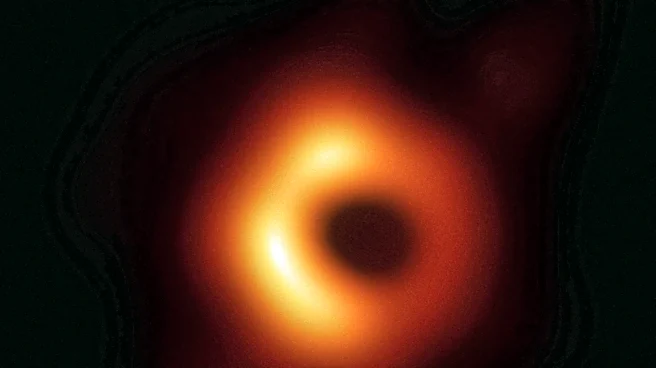
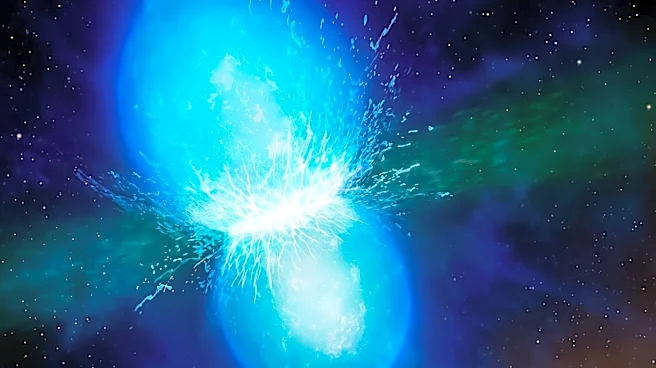
The detection of ultra-high energy neutrinos is crucial for identifying the sources of the universe's most energetic particles, a mystery that current methods cannot fully solve. Unlike charged cosmic rays, which are deflected by magnetic fields and obscure their origins, neutrinos travel in straight lines from their sources. By pinpointing where these neutrinos originate, scientists can learn about the extreme physics driving phenomena like active galactic nuclei (supermassive black holes spitting out particle jets), binary neutron star mergers, and pulsars. This research aims to characterize the magnetic fields, sizes, and physical interactions within these cosmic engines. Furthermore, studying neutrinos at energies unattainable in terrestrial accelerators could reveal new properties of neutrinos themselves or even break the Standard Model of particle physics. Such a discovery would fundamentally alter our understanding of how the universe works at its most basic level, potentially leading to a Nobel Prize-worthy breakthrough.
What's Next?
Vieregg's team is currently analyzing 50 to 60 terabytes of data collected from the PUEO mission, a process that takes nearly a year due to the 'blind' analysis method used in particle physics to avoid bias. The goal is to identify rare neutrino events that would be the highest energy neutrinos ever observed. The RNO-G experiment in Greenland is also ongoing, providing complementary data. In the next decade, Vieregg anticipates significant advancements in neutrino astrophysics, with experiments like IceCube and radio experiments working in conjunction with other datasets to identify and characterize neutrino sources. While a particle physics breakthrough that 'breaks the Standard Model' is less likely to make immediate headlines, it would be a monumental discovery. The scientific community awaits the results of these analyses, which could provide unprecedented insights into the universe's most extreme environments and the fundamental laws governing them.
Beyond the Headlines
The hunt for neutrinos extends beyond astrophysics, touching upon the very nature of scientific inquiry and the human drive to explore the unknown. The 'mystery events' detected by the ANITA experiment, a predecessor to PUEO, which showed inverted radio signals, sparked speculative theories, including the existence of a parallel universe. While such theories are often dismissed by experimentalists, they highlight the public's fascination with cosmic mysteries and the role of theoretical physicists in exploring unconventional explanations. Vieregg emphasizes the importance of presenting data objectively and allowing theorists to propose various interpretations, even if some are 'preposterous.' This collaborative yet critical approach is essential for scientific progress, ensuring that no potential avenue of discovery is overlooked. The dedication required for these experiments, involving long periods in extreme environments like Antarctica and years of data analysis, underscores the profound commitment of scientists to unraveling the universe's deepest secrets.