







What's Happening?
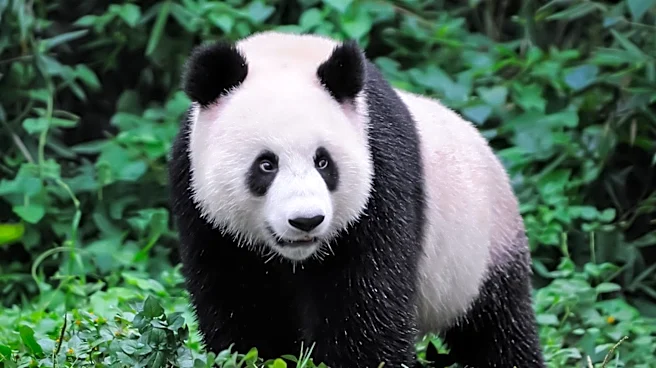
Zoo Atlanta has officially debuted its two newest giant pandas, Ping Ping (male) and Fu Shuang (female), to the public. The six-year-old pandas arrived in September from China under a new 10-year loan agreement, marking the return of the species to the zoo
after a two-year absence. The pandas have spent several weeks acclimating to their newly renovated enclosure before their public appearance. This event renews a long-standing bond between China and Zoo Atlanta, which previously housed pandas for 25 years until four other pandas returned to China in 2024. The Chinese ambassador to the U.S., Xie Feng, emphasized that the pandas' arrival signifies a renewal of this decade-long partnership, expressing hope for their well-being and the joy they will bring to visitors. Zoo Atlanta is now one of three U.S. zoos to house giant pandas, alongside the National Zoo in Washington D.C. and the San Diego Zoo, both of which also recently received new pandas.
Why It's Important?
The return of giant pandas to Zoo Atlanta holds significant cultural and diplomatic importance, symbolizing a continued, albeit evolving, relationship between the United States and China. China has historically used 'panda diplomacy' as a tool for goodwill, and the renewal of these loan agreements suggests a desire to maintain certain cultural ties despite broader geopolitical tensions. For Zoo Atlanta, the pandas are a major attraction, drawing visitors and supporting conservation efforts. The presence of these animals also serves an educational purpose, raising public awareness about wildlife conservation and the importance of international cooperation in protecting endangered species. The reclassification of giant pandas from endangered to vulnerable by the International Union for Conservation of Nature highlights successful conservation efforts, in which these zoo programs play a part by supporting research and public engagement.
What's Next?
Over the next decade, Ping Ping and Fu Shuang will reside at Zoo Atlanta, where they are expected to be a primary draw for visitors and a focus for the zoo's conservation and educational programs. The zoo will continue to monitor their health and adaptation to their new environment, providing updates to the public. The success of this 10-year loan agreement could influence future diplomatic exchanges and conservation partnerships between the U.S. and China. Public engagement and educational initiatives around the pandas will likely increase, aiming to foster greater understanding of wildlife conservation. The ongoing presence of pandas in U.S. zoos will also continue to be a barometer of the cultural and scientific cooperation between the two nations, with future renewals or new agreements depending on the broader diplomatic climate.
Beyond the Headlines
Beyond their immediate appeal, the pandas at Zoo Atlanta represent a complex interplay of conservation, diplomacy, and public sentiment. The 'panda diplomacy' strategy employed by China underscores how cultural exchanges can be leveraged in international relations, often serving as a softer counterpoint to more contentious political issues. The public's emotional connection to these animals can foster a sense of shared global responsibility for wildlife, transcending national borders. However, the temporary nature of these loans also highlights the conditional aspect of such diplomatic gestures, with agreements often reflecting the state of bilateral relations. The return of pandas to U.S. zoos, following a period of strained relations, could be interpreted as a subtle signal of a desire for continued engagement, even if limited to cultural and scientific spheres. This dynamic illustrates the enduring power of shared cultural symbols in navigating complex international landscapes.