


What's Happening?
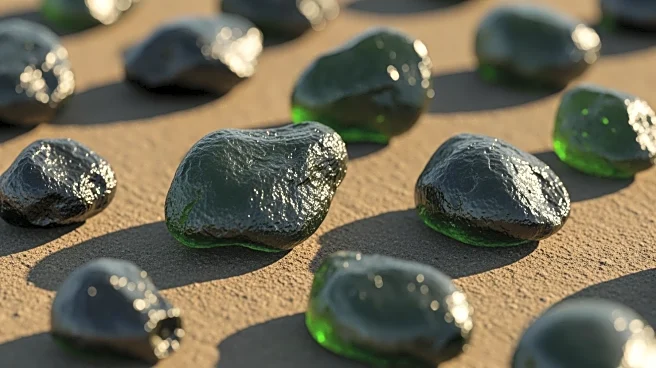
Researchers have discovered a new field of tektites, named geraisites, in the Brazilian state of Minas Gerais. Tektites are natural glasses formed by the high-energy impact of meteorites on Earth's surface. This discovery, led by geologist Álvaro Penteado
Crósta, fills a significant gap in the record of meteorite impacts in South America. The geraisites, found over a 56-mile stretch, are believed to have formed approximately 6.3 million years ago. The tektites exhibit typical aerodynamic shapes and low water content, distinguishing them from volcanic glass. Despite the absence of an associated crater, the discovery suggests a significant impact event, contributing to the understanding of Earth's geological history.
Why It's Important?
The discovery of the geraisites is crucial for understanding the frequency and impact of meteorite collisions in South America, a region with few known large impact structures. This finding suggests that tektites may be more common than previously thought, often overlooked or misidentified. The research provides valuable data on the geological history of the region and the processes involved in tektite formation. It also highlights the potential for discovering more tektite fields, which could offer insights into Earth's past and the dynamics of meteorite impacts.
What's Next?
Further research is needed to locate the impact crater associated with the geraisites, which could provide more precise data on the size and nature of the meteorite. Scientists may also explore other regions in South America for similar tektite fields, potentially revising the understanding of meteorite impact distribution. This discovery could lead to advancements in identifying and classifying tektites, improving the geological record of Earth's impact history.