
What's Happening?
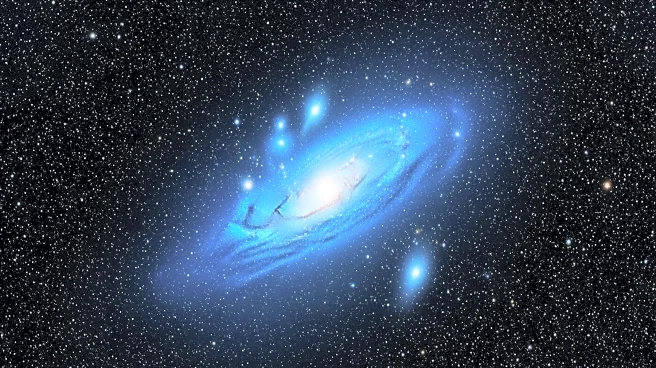
The Hubble Space Telescope has captured a striking image of the blue dwarf galaxy Markarian 178 (Mrk 178), located 13 million light-years away in the constellation Ursa Major. This galaxy, smaller than
the Milky Way, is part of a group of over 1,500 Markarian galaxies, known for their brightness in ultraviolet light. The image reveals a galaxy rich in young, hot stars, with a distinctive red hue from rare massive Wolf–Rayet stars. These stars, located near the galaxy's edge, are in a phase of evolution just before collapsing into black holes or neutron stars. The presence of these stars suggests a recent burst of star formation, possibly triggered by a gas cloud collision or disturbances from the intergalactic medium.
Why It's Important?
The discovery of Wolf–Rayet stars in Mrk 178 provides valuable insights into the lifecycle of massive stars and the processes that lead to star formation in galaxies. Understanding these processes is crucial for astrophysics, as it helps scientists learn more about the evolution of galaxies and the conditions that lead to the formation of new stars. The findings also highlight the capabilities of the Hubble Space Telescope in observing distant galaxies and contributing to our understanding of the universe. This research could have implications for future studies on galaxy formation and the role of massive stars in cosmic evolution.