
What's Happening?
Researchers at the University of Washington have identified a new species of the genus Cimolodon, a group of small, rodent-like mammals that survived the mass extinction event 66 million years ago. The
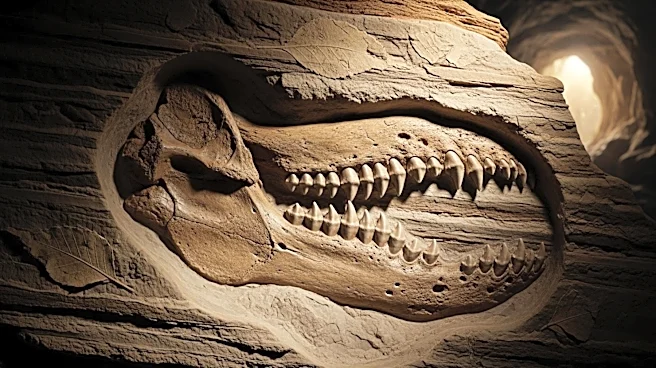
species, named Cimolodon desosai, was discovered in Baja California and is estimated to be around 75 million years old. This discovery provides insights into how early mammals, particularly multituberculates, managed to endure the catastrophic event that wiped out the dinosaurs. The fossil, which includes teeth, a skull, and parts of the skeleton, offers a rare glimpse into the physical characteristics and lifestyle of these ancient mammals.
Why It's Important?
The discovery of Cimolodon desosai is significant as it enhances our understanding of mammalian evolution and survival strategies following the dinosaur extinction. Multituberculates, to which this species belongs, were among the few groups that thrived post-extinction, eventually giving rise to the diverse mammalian species we see today. The study of such fossils helps scientists reconstruct the evolutionary history of mammals and understand the traits that enabled their survival. This research also highlights the importance of fossil sites in Baja California for uncovering pivotal moments in Earth's biological history.
What's Next?
The research team plans to continue studying the fossil to gain further insights into the anatomy and ecology of Cimolodon desosai. Advanced imaging techniques, such as micro-CT scans, will be used to analyze the fossil in greater detail. The findings may lead to the identification of additional species within the Cimolodon genus and contribute to a broader understanding of mammalian evolution. The study also underscores the need for continued exploration and preservation of fossil sites, which are crucial for uncovering the history of life on Earth.