





What's Happening?
U.S. Representative Salud Carbajal announced a significant $20 million grant from the National Science Foundation (NSF) for UC Santa Barbara’s COAST PCL. This facility is one of 20 in a new national network of programmable cloud laboratories. The grant will
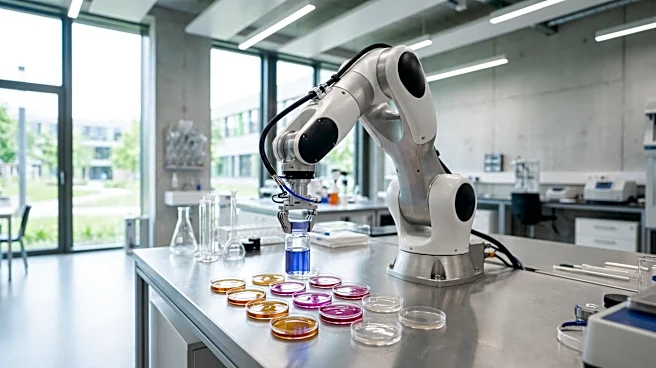
fund the creation of a remotely accessible, AI- and robotics-enabled laboratory dedicated to discovering new polymers and soft materials. Researchers nationwide will be able to design experiments online, have robots conduct them at UCSB, and analyze results without needing to travel to the university. The initial research will focus on sequence-defined polymers and biomolecular materials, with potential applications across various sectors including medicine, energy, electronics, and aerospace. Representative Carbajal highlighted this federal investment during a press conference at UCSB’s OASIS Facility, emphasizing its role in revolutionizing materials research.
Why It's Important?
This $20 million federal grant is crucial for advancing scientific discovery and technological innovation in the United States. By establishing a remotely accessible, AI- and robotics-enabled laboratory at UC Santa Barbara, the initiative democratizes access to cutting-edge research facilities, allowing a broader community of researchers to participate in and benefit from advanced materials science. This approach is expected to accelerate the discovery of new materials with wide-ranging applications, from medical advancements and water purification to microelectronics and aerospace technologies. The integration of AI, computation, and experimentation will streamline the research process, enabling faster generation of data, learning, and validation of predictions. This investment positions the U.S. at the forefront of materials research, fostering breakthroughs that can drive economic growth, create new industries, and address critical societal needs.
What's Next?
The immediate next step involves the establishment and operationalization of the COAST PCL at UC Santa Barbara, utilizing the $20 million NSF grant. This will entail setting up the AI- and robotics-enabled laboratory and developing the remote access infrastructure for researchers across the country. The initial research will concentrate on sequence-defined polymers and biomolecular materials, with the expectation of expanding to other areas. The success of this model could lead to further federal investments in similar programmable cloud laboratories, potentially creating a more interconnected and efficient national research ecosystem. Stakeholders, including other universities, research institutions, and industries, will likely monitor the progress and outcomes of this initiative, potentially seeking to replicate or collaborate with this advanced research model.
Beyond the Headlines
The establishment of the COAST PCL represents a significant shift in how scientific research can be conducted, moving towards a more collaborative, accessible, and technologically integrated model. By enabling remote experimentation through AI and robotics, it addresses geographical barriers and resource limitations, potentially fostering a more inclusive research community. This approach also raises important questions about data sharing, intellectual property in a distributed research environment, and the ethical implications of AI-driven scientific discovery. The long-term impact could include a faster pace of innovation, a reduction in research costs, and the development of novel materials that could fundamentally alter various industries and improve quality of life. It also underscores the growing importance of interdisciplinary collaboration between computer science, engineering, and materials science.