

What's Happening?
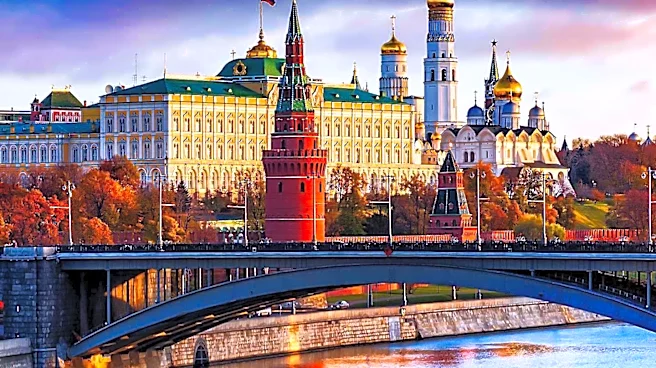
President Vladimir Putin recently visited the sarcophagus of medieval warrior prince Dmitry Donskoy, whose remains were unexpectedly discovered during restoration work at Moscow's Cathedral of the Archangel. The cathedral, located within the Kremlin fortress,
has historically served as the burial site for numerous Russian tsars and princes. While it was known that Grand Prince Donskoy was interred there, the discovery of his body last month in a crypt by the southern wall surprised historians who had believed it was located elsewhere. Putin lit a candle inside the frescoed cathedral and observed the white-stone sarcophagus as experts provided explanations regarding the identification of the 14th-century prince's remains. The Russian Orthodox Church confirmed the discovery, noting the well-preserved and nearly complete remains belonged to a man who died of natural causes between 35 and 45 years old, consistent with historical records.
Why It's Important?
This event holds significant cultural and historical importance for Russia. Dmitry Donskoy, who died in 1389 at the age of 39, was a pivotal figure in Russian history, having ruled the principalities of Muscovy and Vladimir, which formed the foundation of the modern Russian state. His accomplishments include overseeing the construction of the first stone Kremlin fortress, expanding Muscovy's territory, and famously defeating Mongol forces in the Battle of Kulikovo in 1380. President Putin's visit to the newly unearthed remains underscores the Kremlin's emphasis on historical continuity and national identity. By connecting with such a revered historical figure, the visit serves to reinforce a sense of national pride and historical legitimacy, potentially resonating with a populace facing contemporary challenges.
What's Next?
The discovery of Dmitry Donskoy's well-preserved remains is likely to spark further historical and archaeological research into the medieval period of Russia. The Russian Orthodox Church and historical institutions will probably continue to study the remains and the context of their discovery, potentially leading to new insights into the life and times of the Grand Prince. President Putin's public engagement with this historical find suggests that the Kremlin may continue to leverage such cultural events to bolster national sentiment and historical narratives. This could involve further public exhibitions, educational initiatives, or media coverage highlighting Russia's rich historical heritage and the contributions of its past leaders.
Beyond the Headlines
President Putin's visit to the remains of Dmitry Donskoy can be seen as a strategic move to connect the present leadership with a glorious past, particularly during a period of national strain. By associating himself with a figure who unified Russian lands and achieved significant military victories, Putin implicitly draws parallels to his own efforts to strengthen Russia and assert its influence. This act of historical reverence serves a dual purpose: it appeals to a sense of national identity and continuity among the Russian people, and it projects an image of strong, historically rooted leadership. In a broader sense, it highlights how historical narratives and symbols are often utilized by political leaders to shape public perception and reinforce their authority, especially in times of geopolitical tension.