



What's Happening?
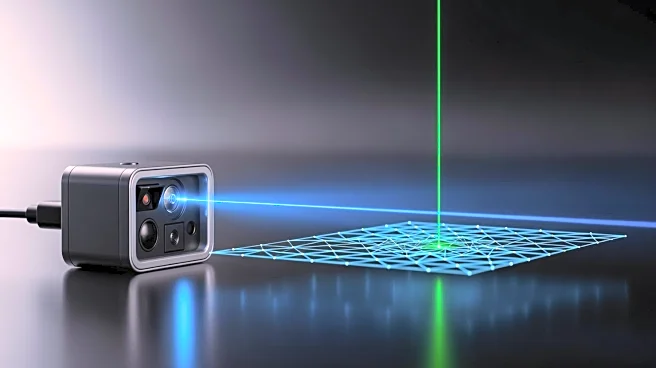
A recent development in LiDAR technology has introduced an ultralight solid-state single-photon LiDAR (SS-SPL) system, which is expected to revolutionize 3D modeling. This system utilizes a super-dense point cloud approach, significantly reducing the
number of photographs needed for data fusion in 3D modeling. The SS-SPL system employs a single short-pulse laser beam and a silicon photomultiplier (SiPM) to detect weak light scattered by objects, converting it into quantized electrical pulses. This technology is designed to improve the geometric fidelity of 3D models by using a single-view full-color photograph instead of multiple photographs. The system's compact design, weighing only 9.97 grams, integrates a Q-switching semiconductor laser and a complementary metal-oxide-semiconductor (CMOS) driver, enhancing its portability and efficiency.
Why It's Important?
The introduction of this ultralight LiDAR system is significant for industries relying on precise 3D modeling, such as autonomous vehicles, drones, and robotics. By reducing the weight and size of LiDAR systems, this technology enables easier integration into smaller platforms like UAVs, potentially expanding their applications. The enhanced precision and reduced data processing requirements could lead to more efficient and cost-effective solutions in fields such as urban planning, environmental monitoring, and infrastructure development. Additionally, the system's ability to operate with lower energy consumption could result in longer operational times for battery-powered devices, further increasing its utility.
What's Next?
As this technology progresses, it is likely to see increased adoption across various sectors. Companies involved in autonomous vehicle development may integrate this LiDAR system to improve navigation and obstacle detection. The reduced size and weight make it an attractive option for drone manufacturers looking to enhance their products' capabilities. Future developments may focus on further improving the system's precision and reducing costs, making it accessible to a broader range of applications. Additionally, regulatory bodies may need to establish new guidelines to accommodate the unique capabilities of this advanced LiDAR technology.
Beyond the Headlines
The deployment of this ultralight LiDAR system could have broader implications for privacy and data security, as the increased precision and range of data collection may raise concerns about surveillance and data management. Ethical considerations regarding the use of such technology in public spaces will need to be addressed. Furthermore, the advancement of LiDAR technology may spur innovation in related fields, such as artificial intelligence and machine learning, as these systems require sophisticated algorithms to process and interpret the vast amounts of data generated.