

What's Happening?
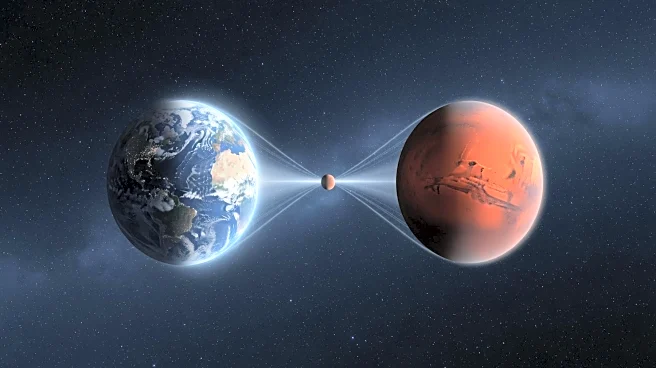
A new study published in the Publications of the Astronomical Society of the Pacific suggests that Mars' gravitational pull plays a significant role in stabilizing Earth's climate. Researchers, led by Stephen Kane from the University of California, Riverside,
used orbital simulations to demonstrate how Mars influences Earth's axial tilt, which is crucial for maintaining climate cycles. The study found that without Mars, Earth would lack certain climate rhythms that drive ice ages and ocean currents. This discovery highlights the interconnectedness of planetary systems and the subtle yet impactful role Mars plays in Earth's climate stability.
Why It's Important?
The findings of this study have profound implications for understanding Earth's climate dynamics and the broader solar system. By revealing Mars' role in stabilizing Earth's climate, the research underscores the importance of considering planetary interactions when studying climate patterns. This knowledge could influence future climate models and inform strategies for addressing climate change. Additionally, the study suggests that similar gravitational interactions could be crucial for maintaining habitable conditions on exoplanets, which is vital for the search for extraterrestrial life. The research highlights the need to consider the entire planetary system when assessing habitability.