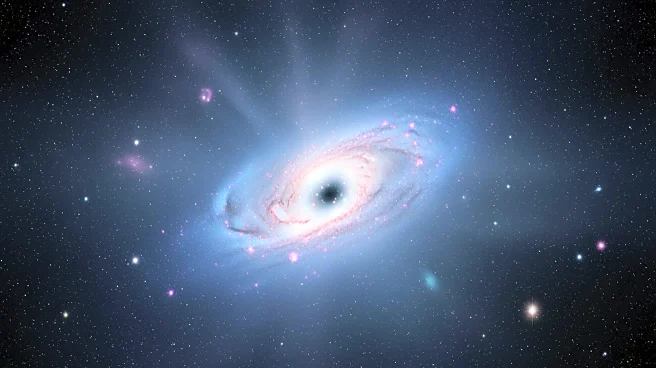




What's Happening?
A giant star in the Andromeda Galaxy, known as M31-2014-DS1, has vanished without a trace, leaving scientists puzzled. Initially observed brightening in 2014, the star faded by 2018 without a supernova explosion. Two studies offer competing explanations:
one suggests a failed supernova leading to a direct collapse into a black hole, while another proposes a stellar merger. The failed supernova theory is supported by observations of a faint red source and a dust shell at the star's location, but lacks expected X-ray emissions. The merger theory suggests two stars collided, forming a new object enshrouded in dust, explaining the lack of X-ray activity and stable infrared signature.
Why It's Important?
The disappearance of M31-2014-DS1 challenges existing theories about the life cycle of massive stars. Typically, such stars end in a supernova, but this case suggests alternative pathways like direct collapse or mergers. Understanding these processes is crucial for astrophysics, as it impacts models of stellar evolution and black hole formation. The findings could lead to new insights into the dynamics of star systems and the conditions leading to different end-of-life scenarios for massive stars.
What's Next?
Further observations and monitoring are needed to distinguish between the failed supernova and merger theories. The James Webb Space Telescope and other instruments will play a key role in gathering more data. Future studies may focus on the dust shell's evolution and any potential re-brightening of the system. Continued research will help refine models of stellar evolution and improve our understanding of the processes governing massive stars' end-of-life stages.