






What's Happening?
NASA, through its Innovative Advanced Concepts (NIAC) program, has awarded a grant for the development of spherical 'Aerobots' named SPARK (Solid-state Propulsion for Autonomous Reconnaissance of Karst). These small, flying vehicles are designed to explore
the underground sinkholes and caves of Saturn's moon Titan, which features a unique 'karst' terrain and hydrocarbon rivers, lakes, and seas. Traditional rovers would struggle to navigate this surface, making flying vehicles a more viable option. Project lead Daniel Drew, an assistant professor at the University of Hawaii at Mānoa, indicated that the SPARK project is currently in a nine-month Phase 1 grant. While it's uncertain if these aerobots will be ready for NASA's Dragonfly mission to Titan, which is targeted for a 2028 launch, a delay in Dragonfly could open possibilities for their later inclusion. Drew's design utilizes novel ion (electric) thrusters, aiming to provide persistence, maneuverability, and robustness in Titan's challenging near-cryogenic conditions, while minimizing disturbance to scientifically important hydrocarbon layering.
Why It's Important?
This NASA funding represents a significant step in advancing exploration capabilities for extreme extraterrestrial environments. Titan, with its Earth-like features and complex subsurface structures, holds immense scientific interest for understanding planetary formation and the potential for life beyond Earth. The development of SPARK's electrohydrodynamic (EHD) propulsion technology could revolutionize how future missions explore not only Titan's caves but also other challenging planetary bodies where conventional propulsion methods are impractical. The ability to navigate and study these hidden environments could yield unprecedented data on Titan's geology, chemistry, and potential for harboring exotic forms of life. Furthermore, the success of such a mission could inspire new approaches to robotic exploration, pushing the boundaries of what is possible in space science and engineering. The project also highlights the importance of early-stage research programs like NIAC in fostering innovative solutions for complex space exploration challenges.
What's Next?
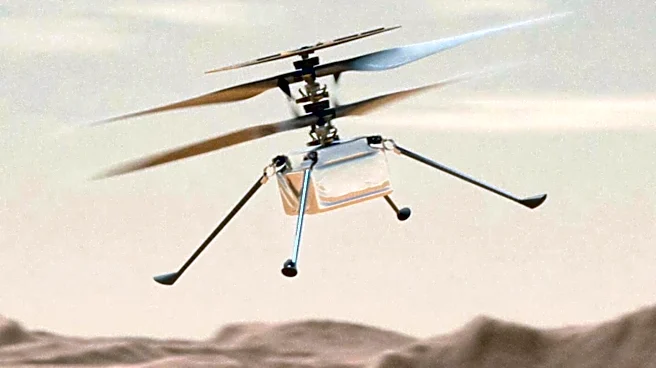
The SPARK project is currently in its nine-month Phase 1 grant, during which Daniel Drew and his collaborators, including Ethan Schaler and Jacob Izraelevitz from NASA's Jet Propulsion Laboratory, and Michael Malaska from the Blue Marble Space Institute of Science, will focus on designing experiments, conducting trade studies for subsystem prioritization (such as power), and modeling thermal effects on the power system. Following Phase 1, the project would need to advance through a two-year Phase 2 to become a more realistic candidate for a mission. While the immediate goal is to develop the technology, its integration into a mission like Dragonfly depends on its readiness and the mission's timeline. Drew hopes SPARK could serve as a cave-exploration forerunner, similar to the Ingenuity helicopter on Mars, demonstrating the capabilities of EHD propulsion. Beyond Titan, the technology could have applications in all-electric aircraft, indoor drones, and mini-flying swarms, although its efficiency limitations might restrict its widespread terrestrial use.
Beyond the Headlines
The development of SPARK's EHD propulsion system touches upon deeper implications for the future of space exploration and robotics. The concept of silent, solid-state propulsion with minimal moving parts offers a paradigm shift in how spacecraft can be designed for longevity and resilience in harsh environments. This technology could enable missions to previously inaccessible areas, such as deep planetary caves or dense atmospheres, expanding our understanding of planetary science. Ethically, the ability to explore these environments without significant disturbance to their natural state is crucial for preserving their scientific integrity. Culturally, successful missions like SPARK could reignite public interest in space exploration, fostering a new generation of scientists and engineers. The long-term shift could see a greater emphasis on agile, adaptable, and specialized robotic explorers, moving beyond the traditional large-scale rover model to a more distributed and nuanced approach to planetary investigation.