





What's Happening?
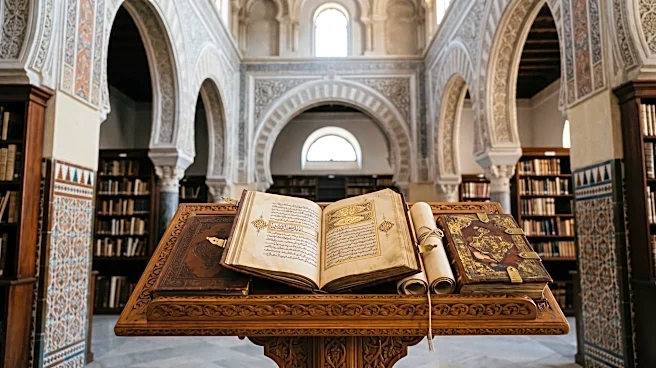
The city of Córdoba, Spain, is being recognized for its rich scholarly history, extending beyond the well-known figures of Averroes and Maimonides. During the tenth century, under the rule of Abd al-Rahman III and his son al-Hakam II, Córdoba became a significant
center for learning. Al-Hakam II is credited with establishing 27 free schools and amassing a vast library, fostering an environment that attracted scholars from various fields. This period saw the rise of figures like Ahmad al-Razi, a court historian and poet, and Mundhir al-Balluti, a chief judge and professor. Later, after the caliphate's dissolution, the city produced scholars such as Ibn Quzman, a zajal poet known for his colloquial verse, and Muhammad al-Qurtubi, a Quran commentator. These individuals represent diverse intellectual contributions, from chronicling court events to administering justice and crafting popular poetry, showcasing Córdoba's broad academic landscape.
Why It's Important?
The emphasis on Córdoba's lesser-known scholars provides a more comprehensive understanding of intellectual life in al-Andalus. It challenges the notion that scholarship was limited to philosophy and science, revealing a vibrant ecosystem that supported historians, judges, poets, and theologians. This historical context is important for appreciating the depth of cultural and intellectual exchange during that era. The example of Mundhir al-Balluti, a judge who adhered to a minority legal school while administering justice according to the prevailing Maliki law, highlights the complexities and nuances of legal and intellectual practice. Furthermore, the inclusion of Ibn Quzman, a poet who used popular speech, demonstrates the breadth of literary expression and the intellectual engagement with everyday life, offering insights into the social fabric of Córdoba beyond its elite circles.
What's Next?
Further exploration of these historical figures and their works could lead to a richer understanding of the intellectual and cultural heritage of al-Andalus. Academic institutions and cultural organizations may continue to research and promote these scholars, potentially leading to new translations, exhibitions, or educational programs. This could attract more academic interest and tourism to Córdoba, focusing on its diverse scholarly contributions. The ongoing study of these historical figures can also inform contemporary discussions about cultural diversity, legal pluralism, and the role of popular culture in intellectual discourse. Future initiatives might aim to make these historical narratives more accessible to a broader audience, fostering a deeper appreciation for the multifaceted history of the region.
Beyond the Headlines
The story of Córdoba's scholars, particularly those who operated outside the most prominent philosophical circles, reveals deeper implications about the nature of knowledge production and dissemination in historical contexts. The patronage of rulers like al-Hakam II underscores the critical role of political support in fostering intellectual growth and maintaining high literacy rates. The existence of figures like Ibn Quzman, who bridged the gap between classical scholarship and popular expression, highlights the dynamic interplay between elite and vernacular cultures. This historical example can prompt reflections on how diverse forms of knowledge are valued and preserved in contemporary society. It also raises questions about the 'canon' of historical figures and the importance of uncovering and celebrating those whose contributions might have been overlooked in favor of more dominant narratives, thereby enriching our collective understanding of intellectual history.