
What's Happening?
Ephesus, located in Turkey's İzmir Province, is a UNESCO World Heritage site renowned for its well-preserved Greco-Roman ruins. The site, which spans approximately 1,600 acres, attracted around 2.5 million
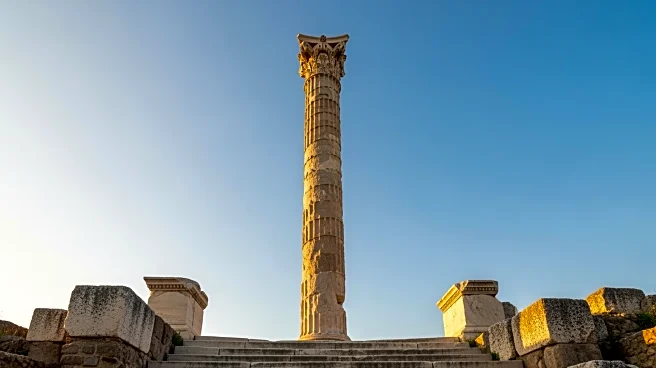
visitors in 2025. Ephesus was historically a major trading hub, connecting the East and West, and has been marked by figures such as Alexander the Great and Antony and Cleopatra. The city features notable structures like the Library of Celsus and the Temple of Hadrian, and offers insights into Roman engineering, including public latrines and baths. The site also holds significance in early Christianity, with connections to Saint Paul and the Virgin Mary.
Why It's Important?
Ephesus serves as a critical link to understanding ancient civilizations, offering insights into Roman architecture, social structures, and early Christian history. Its popularity as a tourist destination highlights the global interest in historical preservation and cultural heritage. The site's ability to attract millions of visitors annually underscores its economic impact on Turkey's tourism industry. Additionally, plans to reconnect the ancient harbor to the sea could further enhance its appeal, potentially increasing tourism revenue and fostering international cultural exchange.
What's Next?
The Turkish government has announced plans to refill the canal and reconnect Ephesus's harbor to the sea, a project that could allow visitors to arrive by sea as they did in ancient times. This initiative, first announced in 2017, aims to enhance the site's historical authenticity and visitor experience. While no timeline for completion has been provided, the project could significantly boost tourism and economic activity in the region. Stakeholders, including local businesses and cultural organizations, may play a role in advocating for the project's timely execution.
Beyond the Headlines
Ephesus's historical significance extends beyond its architectural marvels. The site offers a glimpse into ancient societal norms, such as the use of public baths for social gatherings and the strict social hierarchy evident in the Great Theater. The preservation of religious sites, like the House of the Virgin Mary, highlights the intersection of cultural and religious history. The potential restoration of the harbor could also raise environmental and archaeological considerations, balancing historical accuracy with modern conservation efforts.