




What's Happening?
Physicists at MIT and the University of California at Santa Barbara (UCSB) have developed a new theory to predict how relativistic particles, moving at nearly the speed of light, interact with fluids. This research builds upon Albert Einstein's 1905 theory of Brownian
motion, which described how a particle's movement in a fluid reveals the fluid's microscopic structure. While Einstein's theory works for many fluids, it breaks down under the extreme conditions of quark-gluon plasma, the universe's first fluid, where particles move at relativistic speeds. The new theory calculates the strong nuclear force experienced by a heavy quark as it flies through a gas of weakly interacting quarks and gluons, predicting changes in its momentum. Their findings indicate that for relativistic particles, large 'kicks' from the fluid are more common and unevenly distributed than Einstein's bell-shaped curve predicted, suggesting that primordial quark-gluon plasma is more strongly interacting and liquid-like than previously modeled.
Why It's Important?
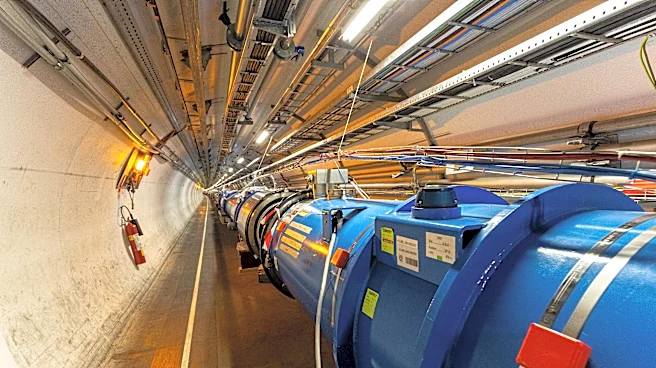
This research is crucial for U.S. scientific endeavors in high-energy physics and cosmology, particularly for understanding the early universe. By providing a more accurate model for how particles behave within quark-gluon plasma, scientists can better interpret experimental data from large particle accelerators, such as those used to recreate this primordial fluid. The ability to characterize the microscopic structure of quark-gluon plasma with greater precision will offer deeper insights into the conditions immediately following the Big Bang. This work, supported by the U.S. Department of Energy’s Office of Science, the U.S. National Science Foundation, and the Simons Foundation, directly impacts the foundational understanding of matter and energy, potentially leading to new discoveries about the fundamental forces of the universe. It refines existing theoretical frameworks and guides future experimental designs in particle physics.
What's Next?
The new theory provides a concrete path forward for understanding quark-gluon plasma using heavy quarks. Researchers envision applying this theory to predict how heavy quarks move through quark-gluon plasma, and then comparing these predictions with experimental results. This comparison will help characterize the microscopic structure of the plasma and determine the nature of the fluid that existed in the universe's first moments. The findings suggest that the primordial quark-gluon plasma is likely more strongly interacting, resembling a liquid rather than a gas. Future experiments in particle accelerators will be critical in validating these theoretical predictions and further refining our understanding of the universe's earliest state. This ongoing interplay between theoretical advancements and experimental verification will continue to push the boundaries of particle physics.
Beyond the Headlines
The refinement of Einstein's Brownian motion theory for relativistic conditions highlights the continuous evolution of scientific understanding, even for long-established principles. This work delves into the very fabric of reality at its most fundamental level, exploring the strong nuclear force that binds quarks and gluons. The implications extend beyond cosmology, potentially influencing other fields where extreme conditions and relativistic speeds are relevant. The concept that the universe's first fluid was more 'liquid-like' than 'gas-like' challenges previous assumptions and opens new avenues for theoretical modeling and experimental investigation. This research underscores the collaborative nature of modern science, with contributions from multiple institutions and significant funding from national scientific bodies, all working towards unraveling the universe's deepest mysteries.