






What's Happening?
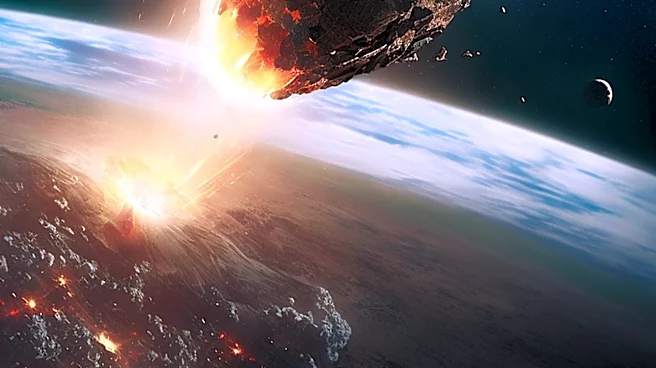
A study led by researchers at the Southwest Research Institute suggests that a massive asteroid breakup in the main asteroid belt, located between Mars and Jupiter, occurred approximately 800 million years ago. This event may have sent numerous rocky
fragments towards Earth, the Moon, and Mars. The collision is believed to have happened in a region known as the J3:1 resonance, a gravitational area influenced by Jupiter's orbit. The shattered pieces from this event are thought to have traveled through the inner solar system over millions of years, potentially causing a prolonged period of impacts on these celestial bodies. The study highlights that this event could explain the presence of large craters on the Moon dating back to the same period. The researchers also suggest that the bombardment may have coincided with significant changes in Earth's climate and the evolution of life.
Why It's Important?
The findings of this study are significant as they provide insights into the history of asteroid impacts on Earth and other planets. Understanding these impacts is crucial because they have played a role in shaping planetary surfaces and potentially influencing biological evolution. The study suggests a possible link between the asteroid impacts and major shifts in Earth's climate and biosphere, although this connection requires further investigation. If proven, such a link could enhance our understanding of how extraterrestrial events have influenced Earth's geological and biological history. Additionally, the research underscores the importance of studying celestial bodies like the Moon, which preserve impact records that are often erased on Earth due to geological processes.
What's Next?
Future research may focus on further investigating the potential connections between asteroid impacts and changes in Earth's climate and biosphere. Scientists may also continue to study the Moon's surface to gather more data on ancient impacts. Additionally, the study of asteroid families and their trajectories could provide more insights into the history of impacts in the solar system. These efforts could help refine models of how asteroid fragments travel through space and their potential effects on planets.
Beyond the Headlines
The study highlights the role of the Yarkovsky effect, a small force that alters asteroid orbits over time, in the movement of asteroid fragments. This effect, along with gravitational influences from Jupiter, plays a crucial role in the dynamics of asteroid movement within the solar system. Understanding these forces can improve predictions of asteroid paths and potential future impacts on Earth. The research also emphasizes the importance of interdisciplinary approaches, combining astronomy, geology, and climate science, to unravel the complex history of our solar system.