




What's Happening?
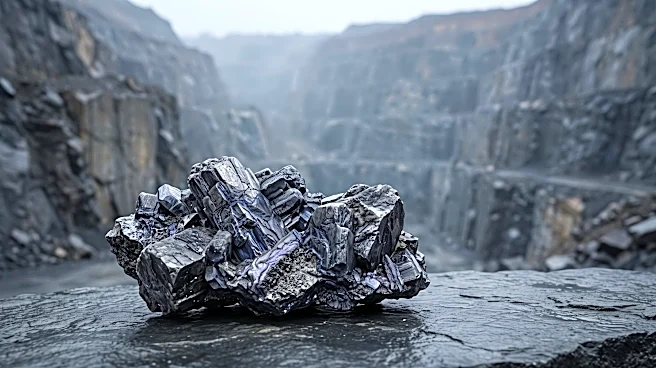
The House Ways and Means Committee recently held a hearing to address the U.S.'s reliance on China for critical minerals, which are essential for various products from smartphones to military equipment. China currently dominates the production or processing
of 30 out of 60 critical minerals designated by the U.S., controlling approximately 90% of global rare earth processing capacity. The Trump administration has prioritized securing critical mineral supply chains since January 2025, signing executive orders to accelerate permitting and expand domestic mineral production. Project Vault, a strategic critical minerals reserve backed by $10 billion from the Export-Import Bank and nearly $2 billion in private financing, was announced in February. Secretary of State Marco Rubio also convened the Critical Minerals Ministerial, establishing the Forum on Resource Geostrategic Engagement (FORGE) for international cooperation. Donald Trump Jr.'s venture capital firm, 1789 Capital, has invested in Vulcan Elements, a North Carolina rare earth magnet manufacturer that has also received federal support, leading to scrutiny over potential conflicts of interest.
Why It's Important?
The U.S.'s heavy dependence on China for critical minerals poses significant economic and national security risks. These minerals are vital for advanced technologies and defense applications, making a secure supply chain crucial. The Trump administration's initiatives, such as Project Vault and FORGE, aim to diversify sourcing and boost domestic production, which could reduce vulnerability to geopolitical tensions and supply disruptions. However, the investment by Donald Trump Jr.'s firm in a federally supported critical mineral manufacturer raises concerns about potential conflicts of interest. This situation highlights the delicate balance between promoting domestic industry and ensuring ethical governance, especially when private financial interests of politically connected individuals intersect with federal policy and funding. The outcome of these efforts will impact U.S. technological independence, economic competitiveness, and national security.
What's Next?
The administration will continue to develop trade policy mechanisms through the Office of the U.S. Trade Representative, seeking stakeholder input on a proposed plurilateral agreement on critical minerals. The bilateral critical mineral frameworks announced at the February ministerial and the FORGE initiative will also be implemented to foster international coordination. Congress is expected to play a role through trade legislation, oversight of critical mineral agreements, and considering longer-term changes to acts like the African Growth and Opportunity Act and Jackson-Vanik restrictions. The scrutiny over Donald Trump Jr.'s firm's investment will likely persist, potentially leading to further investigations or calls for stricter ethics guidelines. The overall goal is to reduce U.S. dependence on China for critical minerals, but disagreements over the best approach, including transparency and environmental standards, will continue.
Beyond the Headlines
The debate over critical minerals extends beyond immediate supply chain concerns to broader geopolitical and environmental implications. Reducing reliance on China could reshape global trade alliances and foster new partnerships with mineral-rich countries, particularly in Africa and Central Asia. However, this shift also brings challenges related to labor and environmental standards in new mining operations. The ethical dimension of private investments by politically connected individuals in federally supported industries underscores the need for robust transparency and accountability mechanisms to prevent undue influence and ensure public trust. This issue also highlights the long-term strategic importance of resource nationalism and the competition among global powers for control over essential raw materials, which will define technological and economic leadership in the coming decades.