





What's Happening?
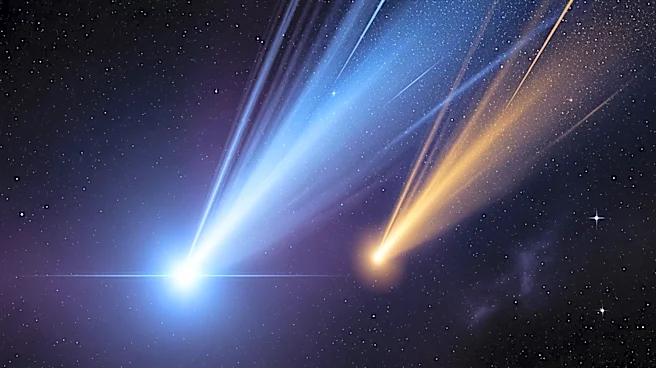
Comet C/2025 R3 (PanSTARRS) recently made a close approach to Earth, showcasing its two distinct tails. As the comet neared the sun, solar radiation caused sublimation, releasing dust and gas from its nucleus. This process formed a broad dust tail and a straighter
ion tail, the latter driven by solar wind. The ion tail, which always points away from the sun, became particularly visible as the comet passed closest to Earth. The event was captured by the Solar and Heliospheric Observatory, providing stunning imagery of the comet's dynamic tails.
Why It's Important?
The observation of Comet PANSTARRS offers valuable insights into the behavior and composition of comets as they interact with solar radiation. Understanding these processes helps astronomers study the early solar system's conditions and the formation of celestial bodies. The event also highlights the capabilities of space observatories in capturing and analyzing cosmic phenomena, contributing to our broader understanding of the universe.
What's Next?
Astronomers will continue to monitor Comet PANSTARRS as it moves away from the sun, analyzing data to refine models of cometary behavior. Future observations of similar comets will further enhance our knowledge of these celestial objects. Additionally, the event serves as a reminder of the importance of maintaining and upgrading space observatories to capture such transient phenomena.