
What's Happening?
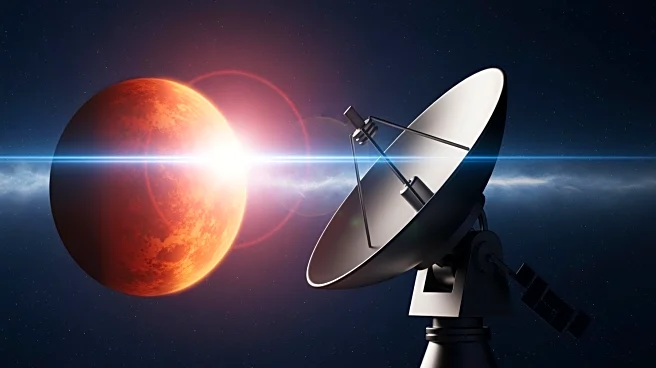
NASA's Mars Atmosphere and Volatile Evolution (MAVEN) spacecraft has lost communication with Earth, raising concerns about the mission's status. The loss occurred on December 6th when the spacecraft failed
to reconnect with NASA's Deep Space Network after passing behind Mars. MAVEN, which has been orbiting Mars since 2013, is designed to study the planet's atmosphere and its interaction with solar wind. The spacecraft's unexpected spin and trajectory change have complicated efforts to reestablish contact. The situation is further challenged by Mars' current position behind the Sun, which naturally disrupts communications. NASA teams are actively investigating the anomaly and are hopeful for a resolution once Mars moves out of solar conjunction in January 2026.
Why It's Important?
The MAVEN mission is crucial for understanding Mars' atmospheric loss and its implications for the planet's history and potential habitability. The data collected by MAVEN over the years has provided insights into the atmospheric conditions that led to the loss of surface water on Mars. The current communication issue threatens to halt this valuable research, which could impact future Mars exploration missions. Additionally, MAVEN's observations are vital for planning upcoming missions, such as the ESCAPADE orbiters set to arrive in 2027. The loss of MAVEN would be a significant setback for NASA's Mars exploration program and the scientific community's understanding of the Red Planet.
What's Next?
NASA is working to resolve the communication issue with MAVEN, but the process is hindered by Mars' solar conjunction, which will last until January 2026. During this period, communication with Mars-based assets is limited. Once Mars emerges from behind the Sun, NASA will attempt to reestablish contact with MAVEN. If successful, the mission could continue its valuable scientific work. In the meantime, NASA is preparing for the arrival of the ESCAPADE orbiters, which will complement MAVEN's research. The outcome of these efforts will determine the future of Mars atmospheric studies and the broader goals of NASA's Mars exploration strategy.