


What's Happening?
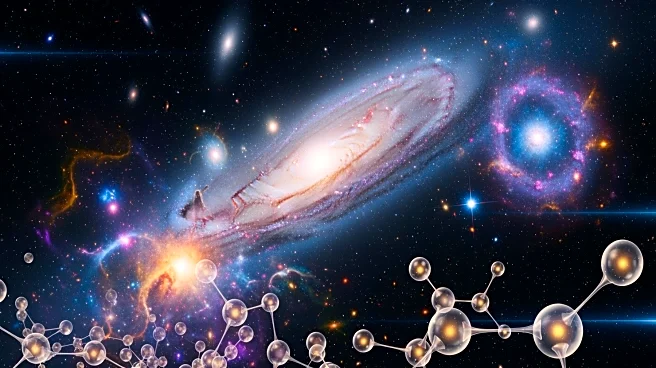
The James Webb Space Telescope (JWST) has revealed a surprising abundance of organic molecules in the galaxy IRAS 07251-0248, challenging existing theories about carbon chemistry in extreme environments. This galaxy, classified as an ultra-luminous infrared
galaxy, is heavily obscured by gas and dust, making it difficult to study with conventional telescopes. However, JWST's infrared capabilities have allowed scientists to detect a variety of organic molecules, including benzene, acetylene, and methane, in quantities far exceeding previous predictions. The research, led by Ismael García Bernete from the Centro de Astrobiología in Spain, suggests that these molecules are being produced in a complex chemical network fueled by a continuous source of carbon within the galaxy's nucleus.
Why It's Important?
This discovery has significant implications for our understanding of galaxy evolution and the role of organic chemistry in the universe. The presence of such complex molecules in a heavily obscured galactic nucleus suggests that these regions may act as molecular factories, producing organic building blocks that could contribute to the chemical evolution of galaxies. The findings challenge existing models of carbon chemistry and highlight the potential for previously unrecognized pathways in the distribution and transformation of carbon within galaxies. This research also underscores the capabilities of the JWST in uncovering hidden aspects of the universe, providing new insights into the processes that govern galaxy formation and evolution.
What's Next?
The researchers plan to extend their study to more ultra-luminous infrared galaxies to determine whether the chemical processes observed in IRAS 07251-0248 are common in other similar galaxies. They aim to build more detailed models of how cosmic rays influence carbonaceous materials and to observe how these molecular factories evolve over time. With JWST's mission just beginning, there are numerous obscured galactic nuclei yet to be explored, promising further revelations about the universe's chemical complexity.
Beyond the Headlines
The findings from IRAS 07251-0248 offer a new perspective on the potential for organic chemistry in extreme environments, suggesting that even the most obscured and radiation-blasted regions of the universe can be rich in molecular diversity. This challenges the notion that such environments are molecular deserts and opens up new avenues for understanding the origins of life and the role of organic chemistry in the cosmos.