
What's Happening?
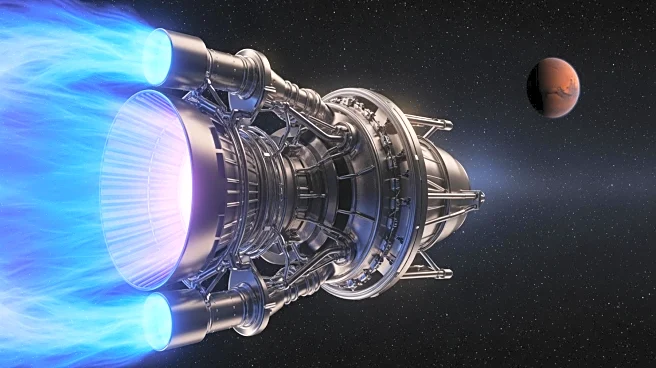
Russia is advancing its space exploration capabilities by developing a plasma engine that could potentially transport humans to Mars in just 30 days. This new technology, spearheaded by Rosatom's Troitsk
Institute in Moscow, represents a significant leap from traditional chemical rockets, which typically take about eight months to reach Mars. The plasma engine, known as a magnetoplasma accelerator, uses ionized propellant accelerated by a magnetic field to create thrust. This method is more efficient and powerful than chemical propulsion. Rosatom claims that their engine can achieve a specific impulse of up to 100 kilometers per second, with a power output of 300 kilowatts, which they describe as unmatched by current technologies. The Russian state corporation aims to have a flight-ready version of this engine by 2030, despite challenges within Russia's space industry.
Why It's Important?
The development of a plasma engine capable of reaching Mars in a month could revolutionize human space travel, significantly reducing travel time and potentially opening new opportunities for exploration and colonization of the Red Planet. This advancement places Russia in a competitive position in the global space race, alongside other nations like the United States and China, who are also investing in similar technologies. For the U.S., this could mean increased pressure to accelerate its own space exploration initiatives to maintain leadership in space technology. The success of such a project could also have broader implications for international collaboration or competition in space exploration, impacting geopolitical dynamics.
What's Next?
If Rosatom's timeline holds, the next few years will be crucial for testing and refining the plasma engine technology. The international space community will likely watch closely to see if Russia can overcome its current industry challenges to deliver on its ambitious goals. Meanwhile, other countries, including the U.S. and China, may intensify their efforts in developing similar technologies to ensure they are not left behind. The potential for partnerships or rivalries in space exploration could shape future policies and investments in the sector.
Beyond the Headlines
The pursuit of plasma engine technology highlights the broader trend of innovation in space propulsion systems, which could eventually extend beyond Mars missions to other deep-space explorations. This technological shift may also influence the development of related industries, such as satellite deployment and space tourism, by providing faster and more efficient travel options. Additionally, the ethical and environmental considerations of increased space travel, such as space debris and planetary protection, will become more prominent as these technologies advance.