
What's Happening?
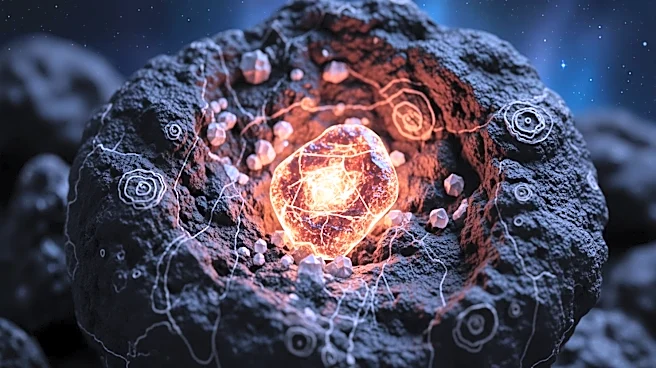
Recent research led by Shea Cinquemani, a graduate from Rutgers School of Environmental and Biological Sciences, suggests that meteor impacts may have created the conditions necessary for life to begin
on Earth. The study, published in the Journal of Marine Science and Engineering, explores the role of hydrothermal vents formed by meteor impacts as potential cradles of life. These vents, which are created when heated, mineral-laden water moves through rock, could have provided the energy and chemistry needed for complex reactions. The research highlights that such environments were likely widespread on early Earth, making them strong candidates for the origin of life. The study began as an undergraduate project and was co-authored with Rutgers oceanographer Richard Lutz.
Why It's Important?
This research provides a new perspective on the origins of life on Earth, suggesting that meteor impacts, often associated with destruction, may have also created conditions suitable for life. By expanding the range of possible locations where life could have originated, this study challenges traditional views that focus solely on deep-sea hydrothermal vents. The findings could also influence the search for life beyond Earth, as similar hydrothermal activity is believed to exist on the ocean floors of icy moons like Jupiter's Europa and Saturn's Enceladus. Understanding these processes on Earth could guide scientists in identifying promising locations for life elsewhere in the solar system.
What's Next?
The study opens new avenues for research into the origins of life, both on Earth and beyond. Scientists may further investigate impact-generated hydrothermal systems to understand their potential to support life. Additionally, the findings could inform future space missions aimed at exploring icy moons and other celestial bodies with similar conditions. As researchers continue to explore these environments, they may uncover more evidence supporting the role of meteor impacts in the development of life.
Beyond the Headlines
The research underscores the importance of interdisciplinary studies in understanding complex scientific questions. By integrating biology, chemistry, physics, and geology, the study offers a comprehensive view of how life might have originated. It also highlights the potential for undergraduate research to contribute significantly to scientific knowledge, as demonstrated by Cinquemani's transition from a class project to a peer-reviewed publication.