




What's Happening?
Researchers, funded by Nasa's Deep Space Food Challenge, have successfully created edible 'cookies' from upcycled plastic and agricultural waste. This innovative technology utilizes specially engineered yeasts to convert plastics and biomass into proteins,
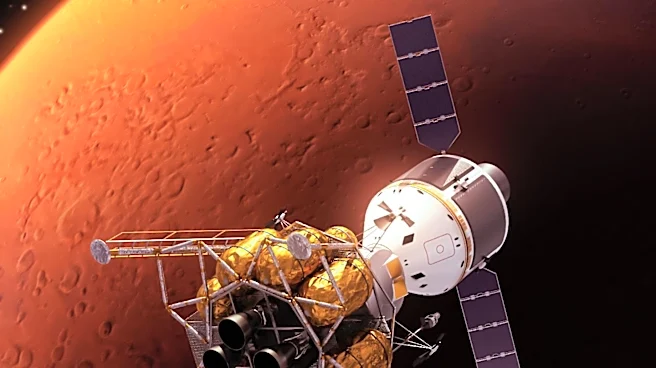
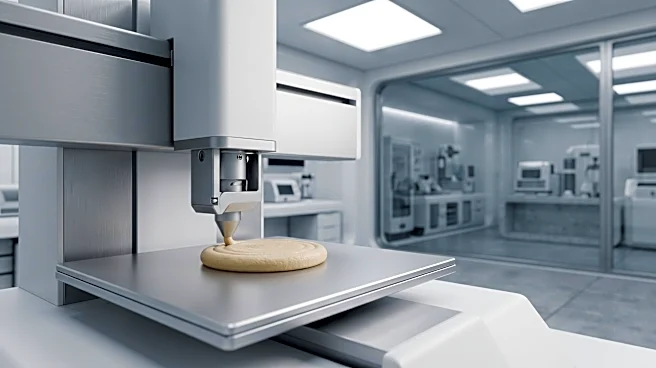
fats, and flavorings. The resulting slurry is then processed through a 3D printer to form disc-shaped 'cookies.' Dr. Lahiru Jayakody, a microbiologist at Southern Illinois University Carbondale, who led the project, highlighted the concept by stating, 'Plastic is carbon and food is carbon.' The team has not yet received institutional approval to taste the plastic-derived cookies but reports that they 'receive high marks on aroma.' The project aims to address the challenge of feeding astronauts on long-duration space missions, such as a three-year round-trip to Mars, where resources are extremely limited. The process involves breaking down polyethylene terephthalate (PET) plastic and other biomass using oxidative hydrothermal dissolution, then feeding these carbon-rich molecules to genetically reprogrammed yeast.
Why It's Important?
This development holds significant implications for future space exploration and potentially for addressing global food security and plastic waste issues on Earth. For space missions, the ability to convert waste into edible food could drastically reduce the amount of supplies needed for long voyages, making deep-space travel more feasible and sustainable. On Earth, this technology could offer a novel solution to the escalating problem of plastic pollution by transforming it into a valuable resource. Furthermore, with global food demand projected to rise significantly by 2050, and a substantial portion of the world's population at risk of hunger, this method presents a potential pathway to create new food sources from readily available waste materials. The concept could also be vital in extreme environments on Earth, such as submarines or disaster zones, where conventional food supply chains are disrupted. The current production cost of $60 per kilogram is expected to decrease with improved yeast efficiency and scaled-up production.
What's Next?
The immediate next step for the research team is to secure institutional approval for human taste tests of the plastic-derived cookies. Following successful testing, efforts will likely focus on improving the efficiency of the yeast strains and scaling up the production process to reduce costs and increase output. The researchers also aim to further enhance the appeal of these 'µBites' by programming yeasts to produce additional food additives, such as vanilla flavoring and beta-carotene. Dr. Jayakody anticipates that these 'cookies' could be ready for public consumption within a few years, suggesting their potential application in various resource-limited environments, including future lunar or Martian colonies. The broader goal is to continue exploring microbial solutions to address the dual challenges of plastic waste and increasing global food demand.
Beyond the Headlines
The development of food from plastic waste raises profound ethical and societal questions regarding public acceptance and the definition of 'food.' While the scientific community focuses on safety and nutritional value, the psychological barrier of consuming plastic-derived products will be a significant hurdle. This innovation challenges conventional notions of waste and resource management, pushing the boundaries of circular economy principles to an extreme. It highlights a potential long-term shift towards bio-engineered food sources, where microbes play a central role in converting unconventional materials into sustenance. The technology could also spur new regulatory frameworks for novel food products and waste upcycling, impacting industries from food production to waste management. Ultimately, this research underscores humanity's ingenuity in adapting to resource constraints and environmental challenges, potentially redefining our relationship with waste and food in the coming decades.