
What's Happening?
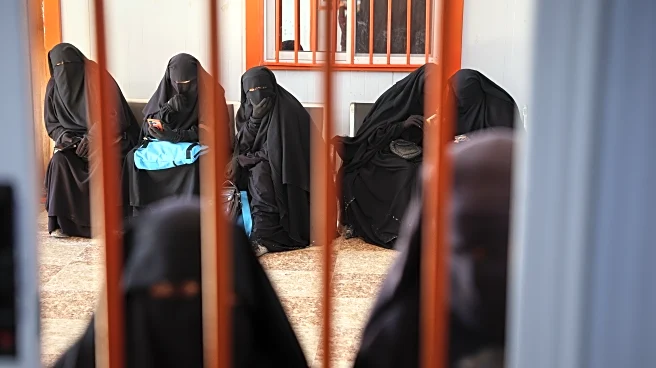
Kurdish-led forces in northeastern Syria have withdrawn from the al-Hol camp, a detention facility housing thousands of families linked to Islamic State terrorists. This move was prompted by the need to defend
Kurdish areas threatened by advancing forces loyal to Syrian President Ahmad al-Sharaa. The withdrawal follows the collapse of an agreement to hand control of Syria’s Kurdish autonomous region to Damascus, leading to clashes between the Syrian Democratic Forces (SDF) and government forces. Despite a ceasefire announced recently, tensions remain high. The Syrian military claims that the withdrawal has enabled a mass escape of detainees from the camp, although this has not been independently confirmed. The al-Hol camp, located near the Syria-Iraq border, is the largest detention facility in Kurdish-controlled territory, holding about 24,000 people, including Syrians and foreign nationals.
Why It's Important?
The withdrawal of Kurdish forces from al-Hol camp and the subsequent security vacuum could have significant implications for regional stability and international security. The potential escape of Islamic State detainees poses a threat not only to Syria but also to neighboring countries and beyond, as these individuals could regroup and reignite terrorist activities. The situation underscores the fragile nature of ceasefire agreements in conflict zones and the challenges of maintaining security in areas with complex political and military dynamics. The involvement of international actors, such as the U.S.-led coalition, highlights the global stakes in ensuring that Islamic State detainees do not escape and pose a renewed threat. Additionally, the developments could impact Kurdish autonomy and their relations with the Syrian government, as the integration of Kurdish forces into Syrian state structures is being negotiated.
What's Next?
The Syrian government and the SDF are in discussions to finalize an agreement that would see the integration of Kurdish forces into Syrian state structures. This includes the potential appointment of Kurdish representatives to various government positions and the incorporation of Kurdish military and security forces into Syria’s defense and interior ministries. The outcome of these negotiations will be crucial in determining the future of Kurdish autonomy in Syria and the stability of the region. Meanwhile, international actors may need to increase their involvement to prevent further security breaches and ensure that Islamic State detainees do not escape. The situation remains fluid, with potential for further conflict or diplomatic resolutions depending on the actions of the involved parties.