



What's Happening?
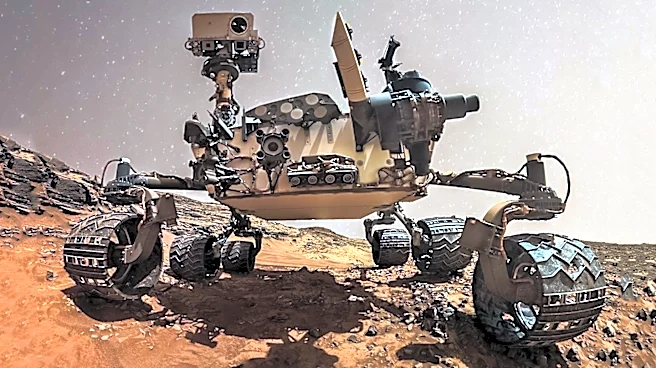
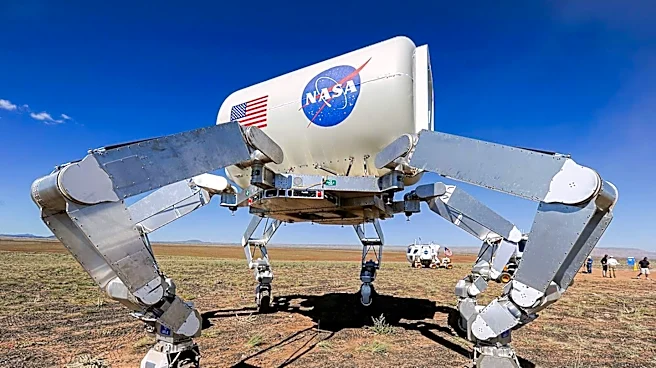
NASA's Jet Propulsion Laboratory (JPL) has successfully tested a new rover prototype, the Exploration Rover for Navigating Extreme Sloped Terrain (ERNEST), in the Southern California desert. The rover completed a 16-mile journey over seven days, operating
almost entirely autonomously. This test is part of NASA's efforts to develop rovers capable of navigating challenging terrains on the moon and Mars. ERNEST features advanced wheels and an active suspension system, allowing it to overcome obstacles and navigate difficult landscapes. The rover's intelligence is enhanced by reinforcement learning, which was initially conducted in a virtual environment. This technology aims to enable future rovers to travel farther and faster than current models, such as Perseverance and Opportunity.
Why It's Important?
The successful testing of ERNEST represents a significant advancement in autonomous rover technology, which is crucial for future space exploration missions. By developing rovers that can navigate extreme terrains with minimal human intervention, NASA can explore previously inaccessible areas on the moon and Mars. This capability could lead to new scientific discoveries and a better understanding of these celestial bodies. The technology also has potential applications in other fields, such as autonomous vehicles on Earth, enhancing navigation systems in challenging environments. The development of ERNEST underscores NASA's commitment to advancing space exploration technology and maintaining its leadership in the field.
What's Next?
Following the successful test, NASA plans to use ERNEST as a model for developing larger and more capable rovers. These future rovers are expected to travel at higher speeds and cover greater distances, further expanding the scope of exploration missions. The technology developed for ERNEST will likely be integrated into upcoming missions to the moon and Mars, supporting NASA's long-term goals of human exploration and settlement. Continued testing and refinement of the rover's systems will be essential to ensure reliability and performance in the harsh conditions of space.