

What's Happening?
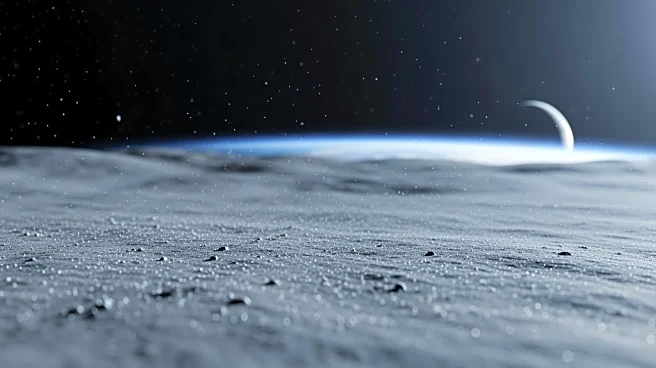
Recent research led by the University of Rochester has revealed that particles from Earth's atmosphere have been transported to the Moon via the solar wind, embedding themselves in the lunar soil. This discovery challenges previous assumptions about the Moon's
composition and the role of Earth's magnetic field. The study suggests that Earth's magnetic field, rather than solely acting as a shield, may guide atmospheric particles into space, allowing them to reach the Moon. This process has resulted in the accumulation of water, nitrogen, and other life-supporting elements on the lunar surface, which were previously thought to be primarily delivered by the solar wind.
Why It's Important?
The findings have significant implications for future lunar exploration and resource utilization. The presence of Earth-derived volatiles on the Moon could provide essential resources for sustaining human presence, such as water and air, reducing the need for costly resupply missions from Earth. This could make lunar bases more economically viable. Additionally, the Moon's regolith, enriched with Earth's atmospheric particles, offers a unique archive of Earth's atmospheric history, potentially providing insights into past climate changes and atmospheric conditions. This could enhance our understanding of planetary habitability and atmospheric evolution, not only for Earth but also for other planets like Mars.
What's Next?
Future lunar missions may focus on targeted sampling of the Moon's regolith to further analyze the isotopic composition of these particles, distinguishing between Earth-sourced and other extraterrestrial materials. This could involve collecting samples from various depths and locations on the Moon to better understand the distribution and concentration of these volatiles. Such research could inform the development of technologies for in-situ resource utilization, crucial for long-term lunar habitation. Additionally, the study's approach could be applied to other celestial bodies, offering insights into their atmospheric histories and potential for supporting life.
Beyond the Headlines
The study opens new avenues for understanding the interplay between magnetic fields, solar winds, and atmospheric retention on planets. By examining how Earth's magnetic field influences the transport of atmospheric particles, researchers can gain insights into the conditions necessary for maintaining atmospheres conducive to life. This knowledge could be pivotal in the search for habitable exoplanets and understanding the factors that contribute to planetary habitability. The Moon, serving as a stable archive, could become a key site for studying these processes over geological timescales.