



What's Happening?
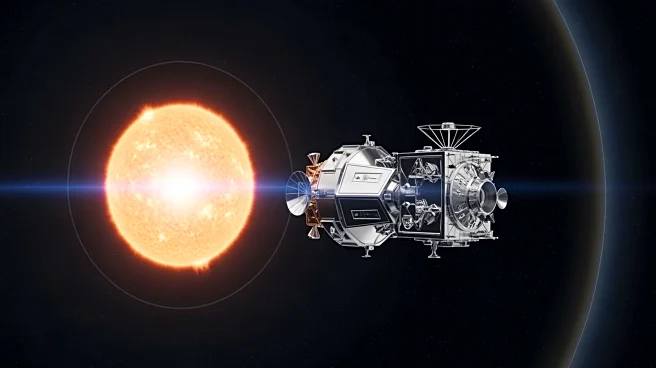
NASA's Interstellar Mapping and Acceleration Probe (IMAP) has successfully reached the first Sun-Earth Lagrange point (L1) after a journey of over three months, covering nearly a million miles. Launched on September 24, 2025, aboard a SpaceX Falcon 9
rocket from Kennedy Space Center, IMAP is now positioned to begin its mission of mapping the outermost boundary of the heliosphere. This boundary acts as a magnetic shield protecting the solar system from galactic radiation. The spacecraft's arrival at L1, a gravitationally balanced point between the Earth and Sun, allows it an uninterrupted view of solar particles and interstellar material. The mission, led by the Johns Hopkins Applied Physics Laboratory, aims to provide a three-dimensional, time-varying map of the heliosphere using IMAP's ten scientific instruments.
Why It's Important?
The successful positioning of IMAP at L1 is significant for several reasons. It enhances our understanding of the heliosphere, which is crucial for comprehending how the solar system is shielded from cosmic radiation. This knowledge is vital for space weather forecasting, which impacts communication systems, power grids, and space missions. The data collected by IMAP will also contribute to the IMAP Active Link for Real-Time (i-alirt) system, improving the accuracy and timeliness of space weather forecasts. This mission represents a critical advancement in heliophysics, offering insights that could influence future space exploration and the protection of Earth-based technologies from solar phenomena.
What's Next?
IMAP is set to begin full operations on February 1, following its successful arrival and initial data collection. The mission will continue to monitor and map the heliosphere, providing real-time data to support space weather forecasting. The insights gained from IMAP's observations will likely inform future heliophysics missions and contribute to the development of technologies designed to mitigate the effects of solar storms on Earth. As the mission progresses, scientists anticipate gaining a deeper understanding of the heliosphere's dynamics and its role in shielding the solar system.