


What's Happening?
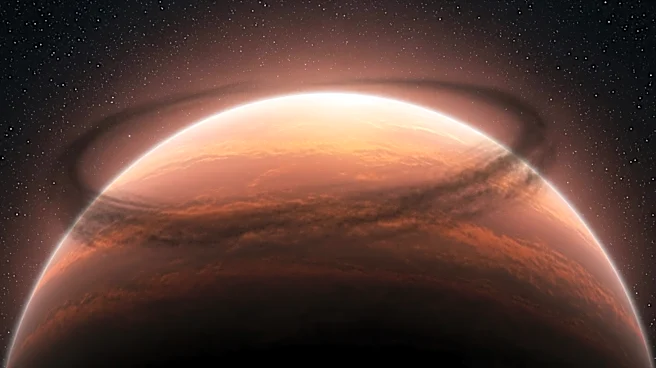
A study led by Jeehyun Yang from the University of Chicago suggests that mini-Neptune exoplanets may produce vast clouds of soot in their atmospheres, akin to natural diesel engines. These exoplanets, which are common yet enigmatic, may have atmospheres filled
with polycyclic aromatic hydrocarbons (PAHs), similar to those found in diesel exhaust. The study proposes that these PAHs form under high-pressure, high-temperature conditions, creating opaque atmospheres that obscure the planets' true compositions.
Why It's Important?
Understanding the atmospheric composition of mini-Neptunes is crucial for determining their formation and migration history. The presence of soot could explain the featureless spectra observed by telescopes like the James Webb Space Telescope, providing insights into the planets' origins and characteristics. This research highlights the potential for interdisciplinary approaches, such as chemical engineering, to advance our understanding of exoplanetary science.
Beyond the Headlines
The study's findings could reshape our understanding of exoplanet formation and migration, offering clues about the diversity of planetary systems. By analyzing the carbon-to-oxygen ratio in the soot, scientists may be able to infer the distance from the star at which these planets formed. This research also raises questions about why similar planets are absent in our solar system, prompting further exploration of planetary formation theories.