


What's Happening?
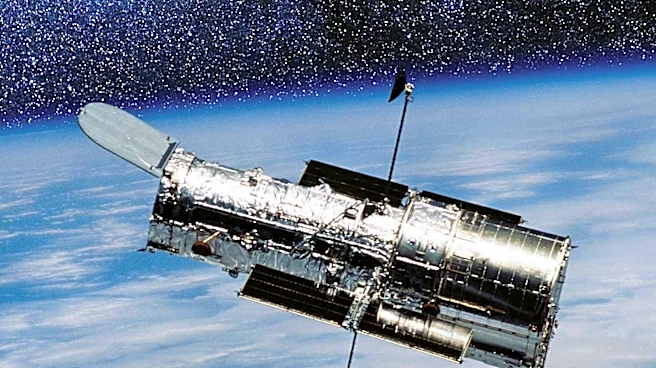
The Hubble Space Telescope has provided evidence of a significant collision and merger between our Milky Way galaxy and a dwarf galaxy, named LKH, approximately 11.8 billion years ago. This event occurred just two billion years after the Big Bang, when
the Milky Way was considerably smaller. Researchers, led by Davide Massari of the Astrophysics and Space Science Observatory of Bologna, identified a third population of globular clusters that are neither native to the Milky Way nor associated with the previously identified Gaia–Sausage–Enceladus (GSE) galaxy merger, which happened about 10 billion years ago. These newly discovered clusters are believed to have originated from LKH. The team calculated LKH's total mass to be 500 million times that of our sun, a substantial contribution to the early Milky Way's mass, including stars, gas, and dark matter. This discovery adds a crucial event to the Milky Way's evolutionary timeline, predating the GSE merger.
Why It's Important?
This discovery significantly alters our understanding of the Milky Way's formation and early evolution. Previously, some studies suggested that the earliest phases of our galaxy's development were primarily driven by stars born within the Milky Way itself. However, the identification of the LKH merger indicates that external galaxies played a vital role in shaping our galaxy from its nascent stages. This ancient collision would have contributed a substantial amount of mass, including dark matter, and could have triggered new bursts of star formation, accelerating the Milky Way's growth. Furthermore, the chemical composition of stars from LKH would have influenced the overall chemical evolution of the Milky Way as these stars completed their life cycles and contributed their elements to the interstellar medium, which then formed new stars. This highlights the dynamic and complex nature of galactic evolution, emphasizing the importance of mergers in the growth of large galaxies.
What's Next?
Future research will likely focus on further analyzing the characteristics of the globular clusters attributed to LKH to gain more detailed insights into the dwarf galaxy's properties and the precise dynamics of the merger. Astronomers will continue to use advanced telescopes and observational techniques to search for other ancient merger events that might have contributed to the Milky Way's formation. The data from the Hubble Space Telescope, combined with information from missions like the European Space Agency's Gaia, will be crucial in refining models of galactic evolution. This ongoing work aims to build a more complete 'biography' of our home galaxy, understanding how it assembled its stars, gas, and dark matter over billions of years. The insights gained could also inform our understanding of galaxy formation processes across the universe.
Beyond the Headlines
The identification of the LKH merger underscores a broader paradigm in astrophysics: that galaxies are not static entities but rather grow and evolve through a series of interactions, including collisions and mergers. This finding challenges the notion of a purely internal growth model for the Milky Way's early history, emphasizing the interconnectedness of cosmic structures. It also highlights the power of 'galactic archaeology,' using the remnants of ancient events, like globular clusters, to reconstruct the distant past of our universe. The presence of dark matter in the LKH dwarf galaxy, contributing to the Milky Way's mass, further reinforces the critical role of this invisible substance in galactic dynamics and structure formation. Understanding these ancient mergers is essential for comprehending the distribution of matter, the chemical enrichment of galaxies, and ultimately, the conditions that allowed for the formation of planetary systems like our own.