



What's Happening?
Egypt has finalized renewable energy agreements valued at $1.8 billion, focusing on large-scale solar power generation and significant battery storage, alongside a local manufacturing component. These deals, signed in the Suez Canal Economic Zone, aim
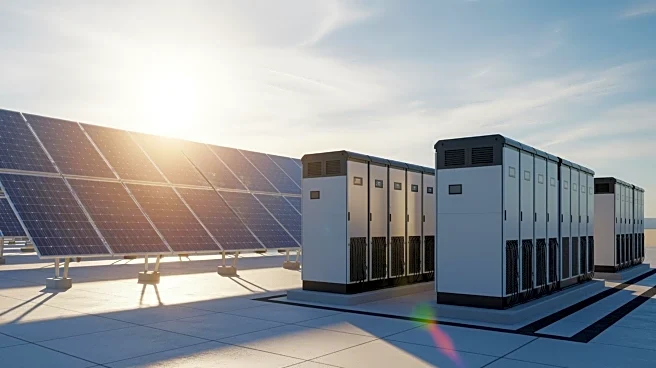
to boost the share of renewables in Egypt's energy mix by 2030. The largest project involves Scatec ASA, which has secured power purchase agreements for 1.95 gigawatts of solar capacity and 3.9 gigawatt-hours of battery storage. However, there is a slight discrepancy in figures, as the government describes the Minya project as a 1.7 GW plant with 4 GWh of storage. Additionally, an agreement with Sungrow Power Supply will establish a battery-manufacturing facility in the Suez Canal Economic Zone, supporting the Minya project and reducing import dependency.
Why It's Important?
These agreements are crucial for Egypt's strategy to increase renewable energy's share to 42% by 2030. The projects are expected to enhance the dispatchability of solar power, reduce reliance on fossil fuels, and smooth grid integration. The $1.8 billion investment indicates significant capital flow, though questions remain about the distribution of funds between equipment supply, local investment, and project financing. The establishment of a local battery manufacturing facility is aligned with Egypt's goals to build domestic value chains and position itself as a regional energy hub. However, the success of these projects will depend on reconciling contractual commitments, ensuring commercial viability, and managing currency exposure.
What's Next?
The next steps involve confirming the final terms of the power purchase agreements, the financing structure, and construction timelines. These factors will determine the projects' impact on Egypt's energy mix and fiscal exposure. The projects' success will also depend on the pace of grid connection and permitting, as well as the local-content requirements and transfer of manufacturing expertise from the Sungrow facility. If implemented as planned, these projects could significantly advance Egypt's renewable energy ambitions.