




What's Happening?
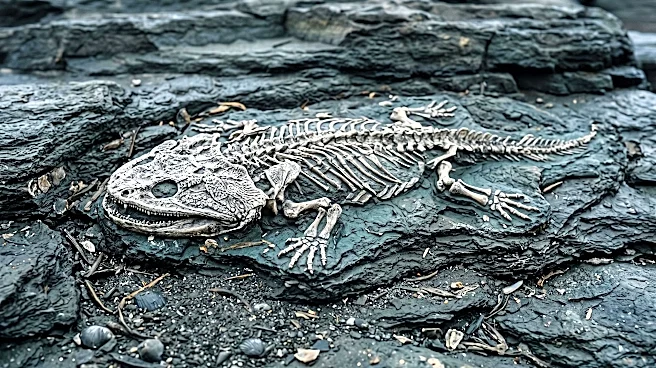
Researchers have unearthed two nearly complete skeletons of an amphibian, named Gerrothorax maritimus, in China’s Guizhou Province. This discovery marks the first known amphibian, extinct or extant, with a fully marine lifestyle. The creature lived approximately
237 million years ago during the Triassic Period, predating dinosaurs. Measuring about 30 inches (75 cm) long, Gerrothorax maritimus possessed a flat, disc-shaped, and armored body, along with a wide mouth indicative of a bottom-dwelling suction feeder. Paleobiologist Ryosuke Motani of the University of California, Davis, a lead researcher, highlighted the significance of finding an early amphibian that lived entirely in the sea. The fossils were found in rocks formed from ocean sediment, alongside marine reptile fossils, supporting its marine existence. Its bony armor is believed to have protected it from predators like ichthyosaurs and aided its adaptation to saltwater by inhibiting seawater absorption through its skin, requiring it to drink saltwater and filter it through gills.
Why It's Important?
This discovery significantly alters the understanding of amphibian evolution and adaptation. Previously, amphibians were thought to be largely restricted to freshwater or terrestrial environments due to their permeable skin, which is ill-suited for saltwater. The existence of Gerrothorax maritimus demonstrates that at least one amphibian lineage successfully adapted to a fully marine environment, challenging long-held biological assumptions. This finding provides crucial insights into exaptation, where a trait evolved for one purpose (armor for freshwater predator defense) is repurposed for another (saltwater protection). It expands the known ecological niches occupied by ancient life forms and offers a unique case study in evolutionary biology, showing the diverse pathways life can take to overcome environmental challenges. The chemical signature in its bones, consistent with Triassic seawater, further solidifies the evidence of its marine life cycle.
What's Next?
Future research will likely focus on further analyzing the physiological mechanisms Gerrothorax maritimus employed to survive in a marine environment. Scientists may investigate the specific composition of its armor and gill structures to understand how it managed osmoregulation and respiration in saltwater. Comparative studies with modern amphibians that exhibit some salt tolerance, such as the crab-eating frog, could provide deeper insights into the evolutionary pressures and adaptations involved. Paleontologists may also search for more fossils of Gerrothorax maritimus or related species to build a more complete picture of its life cycle, diet, and ecological role within the Triassic marine ecosystem. This discovery could also inspire broader investigations into other ancient species that might have similarly defied conventional ecological boundaries.
Beyond the Headlines
The discovery of Gerrothorax maritimus has profound implications beyond paleontology, touching upon fundamental questions in evolutionary biology and the limits of adaptation. It highlights the incredible plasticity of life and its capacity to evolve solutions to seemingly insurmountable environmental barriers. This ancient amphibian's success in a marine environment, despite the inherent challenges of amphibian physiology, underscores the concept that evolutionary pathways are often more complex and unexpected than initially theorized. It serves as a powerful reminder that the fossil record continues to reveal novel forms of life that challenge current biological paradigms, encouraging a more open-minded approach to understanding the potential for life to thrive in extreme or unusual conditions. The 'charming' and 'comical' appearance, as described by researchers, also adds a unique narrative to the story of prehistoric life.