
What's Happening?
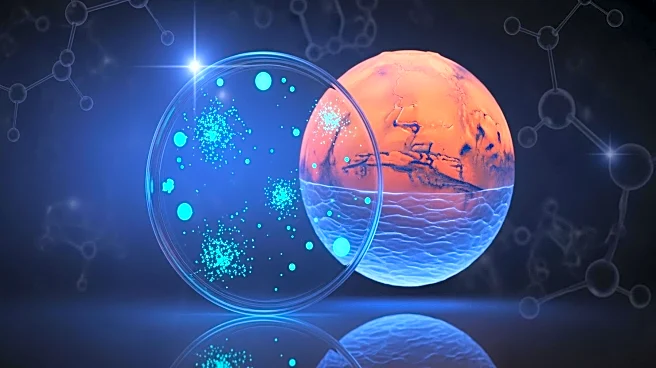
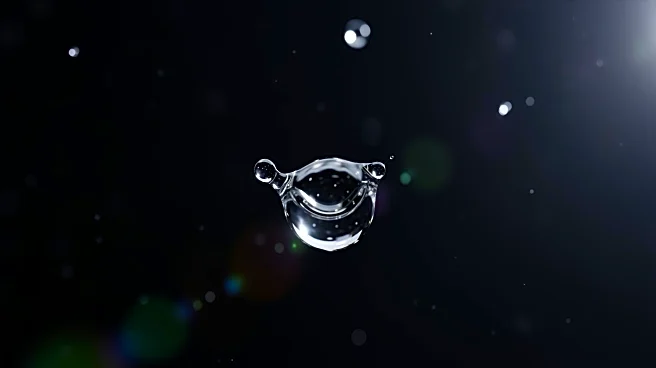
NASA is conducting the Fluid Particles experiment aboard the International Space Station (ISS) to study the behavior of particles in microgravity. The experiment involves a bulk container filled with viscous fluid and embedded particles, subjected to oscillating
frequencies to observe clustering and structure formation. This research, conducted inside the Microgravity Science Glovebox (MSG) in the ISS's Destiny laboratory module, aims to advance understanding in areas such as fire suppression, lunar dust mitigation, and plant growth in space. The findings could also have applications on Earth, including insights into pollen dispersion, algae blooms, and plastic pollution.
Why It's Important?
The Fluid Particles experiment is significant for both space exploration and terrestrial applications. Understanding particle behavior in microgravity can inform the development of technologies for long-duration space missions, such as those planned under NASA's Artemis program and future human expeditions to Mars. On Earth, the research could lead to advancements in environmental science and technology, addressing challenges like pollution and resource management. The experiment exemplifies the dual benefits of space research, contributing to scientific knowledge and practical solutions for global issues.