

What's Happening?
The European Union has signed a significant trade agreement with South American nations, forming what is being hailed as the world's largest free-trade zone. This agreement, involving the Mercosur bloc which includes Brazil, Argentina, Paraguay, and Uruguay,
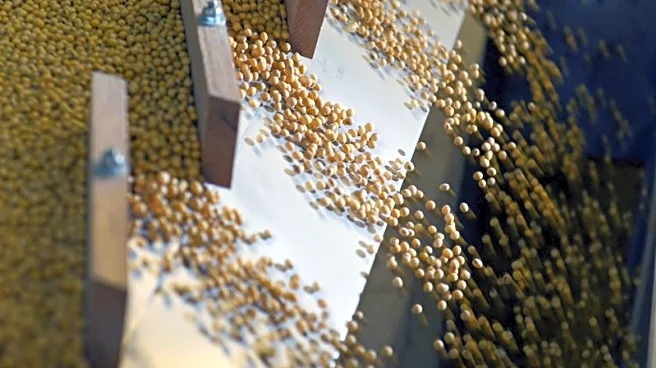
aims to reduce tariffs on various products, such as Argentine beef and German cars. The deal, over 25 years in the making, comes at a time when the E.U. is seeking to assert its role in global trade amidst U.S. protectionist policies under President Trump. European Commission President Ursula von der Leyen emphasized the agreement as a symbol of partnership and a move towards fair trade over tariffs. The deal, however, faces opposition from some E.U. member states concerned about environmental impacts and the potential economic effects on local farmers.
Why It's Important?
This trade agreement is significant as it represents a strategic shift for the E.U. in response to U.S. tariffs and changing global trade dynamics. By establishing a large free-trade zone, the E.U. aims to strengthen its economic ties and reduce reliance on the U.S. This move could potentially enhance the E.U.'s global influence and economic independence. The deal also highlights the E.U.'s commitment to maintaining open markets, contrasting with the protectionist stance of the U.S. under President Trump. Economically, while the immediate impact may be modest, the agreement is seen as a geopolitical signal of the E.U.'s intent to diversify its trade partnerships and secure strategic resources.
What's Next?
The trade agreement now awaits ratification by the European Parliament, a process that could take several months. Opposition from countries like France and Poland, primarily due to concerns over environmental protection and the impact on local agriculture, could pose challenges. The E.U. will need to address these concerns to secure the necessary support. Additionally, the E.U. is likely to continue pursuing other trade agreements, such as with India, to further diversify its economic partnerships. The outcome of this agreement could influence future trade negotiations and the E.U.'s approach to global trade relations.
Beyond the Headlines
The E.U.'s decision to proceed with this trade agreement despite internal opposition underscores the bloc's strategic priorities in the face of global economic shifts. The deal could set a precedent for how the E.U. navigates trade relations with other regions, particularly in balancing economic interests with environmental and social considerations. It also reflects a broader trend of regional blocs seeking to assert their economic autonomy in a multipolar world. The success of this agreement could influence the E.U.'s ability to negotiate similar deals in the future, potentially reshaping global trade patterns.