



What's Happening?
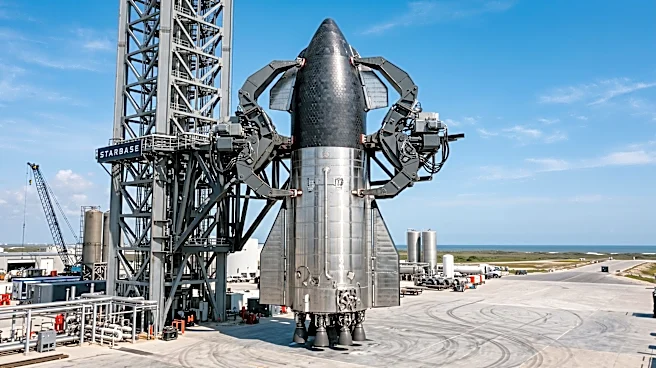
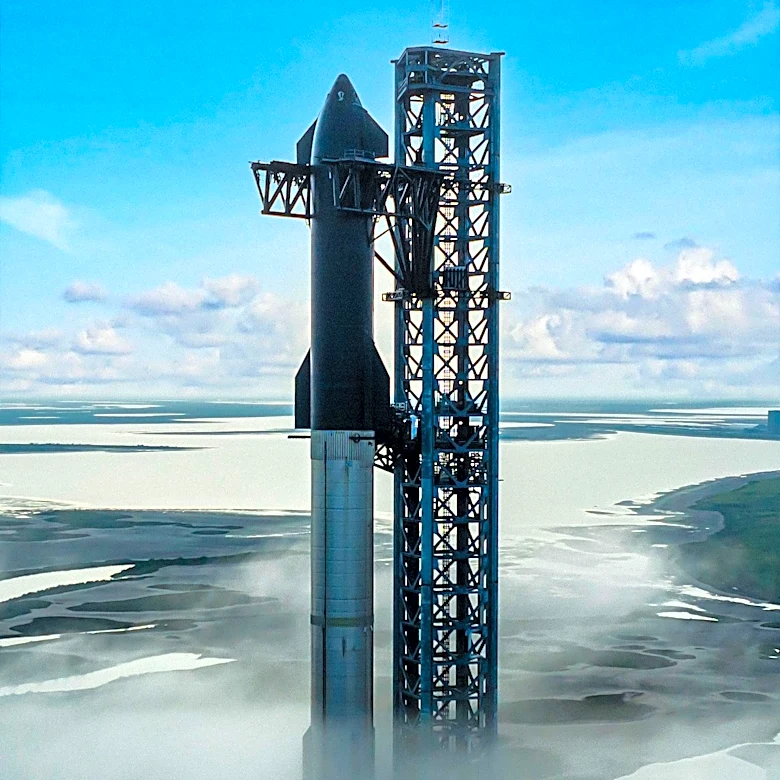
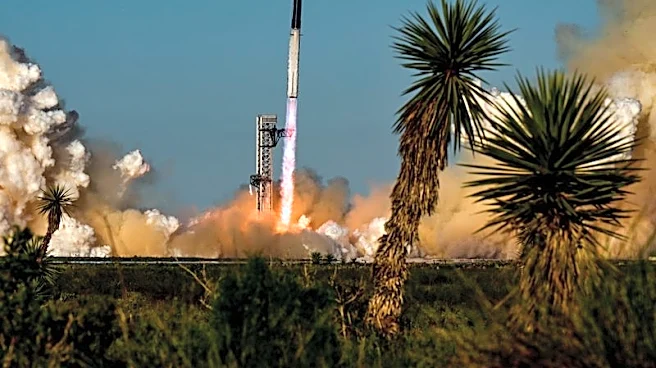
SpaceX has achieved a significant milestone with its Starship program, successfully catching the Ship 42 upper stage with its Mechazilla launch tower arms in Texas after a 22.5-hour orbital mission. This historic recovery occurred just one day after the Super
Heavy booster was diverted into the Gulf of Mexico. Ship 42 completed 14 orbits of Earth and deployed 26 Starlink satellites before returning to Starbase, Texas. During its descent, three Raptor engines ignited to slow the vehicle and rotate it into a vertical position, allowing the mechanical arms of the launch tower to secure it. This marks the first time SpaceX has successfully caught an orbital Starship upper stage, demonstrating a crucial step towards the full reusability of its giant rocket. SpaceX founder and CEO Elon Musk congratulated his team and suggested that Ship 42 might be capable of another flight after relatively limited refurbishment.
Why It's Important?
This successful recovery is a critical advancement for SpaceX's goal of achieving rapid, low-cost reusability for its Starship system. Full reusability, akin to commercial aircraft operations, is essential for significantly reducing the cost of space travel and enabling ambitious missions to the Moon and Mars. The ability to recover and potentially re-fly the Starship upper stage after an orbital mission provides invaluable data on its performance, heat shield integrity, and engine condition. This achievement directly impacts NASA's Artemis program, which has selected a modified version of Starship as a lunar lander. Demonstrating orbital recovery is a foundational step towards proving Starship's capabilities for transporting astronauts and large payloads, thereby accelerating future space exploration and the expansion of the Starlink satellite network.
What's Next?
The immediate next step for SpaceX involves thoroughly inspecting Ship 42 to assess the extent of refurbishment needed before another flight. While Elon Musk has indicated that the spacecraft appears to be in good condition and could potentially fly again within weeks, achieving rapid, aircraft-like reuse requires numerous small fixes and zero expected refurbishment beyond scheduled maintenance. SpaceX will continue to investigate the cause of the Super Heavy booster's premature engine shutdown during its return, which led to its diversion into the Gulf of Mexico. Future Starship missions will aim to demonstrate additional capabilities, such as orbital refueling and controlled lunar landings, which are necessary for NASA's Artemis program and SpaceX's long-term goals of Moon and Mars colonization. The company also plans to introduce a larger Starship V4, which will be approximately 70 meters long with more propellant capacity and additional Raptor-Vacuum engines.
Beyond the Headlines
The successful Starship catch represents a paradigm shift in spaceflight, moving closer to a future where rockets are routinely reused, dramatically lowering launch costs and increasing access to space. This development has profound implications for various sectors, including satellite deployment, space tourism, and deep-space exploration. The engineering challenges overcome in achieving this feat highlight the innovative spirit driving the commercial space industry. However, the incident with the Super Heavy booster also underscores the inherent complexities and risks associated with cutting-edge aerospace technology. The pursuit of full reusability also raises questions about the environmental impact of frequent launches and re-entries, as well as the long-term sustainability of space operations. This achievement sets a new benchmark for rocket technology and will likely inspire further advancements in reusable launch systems globally.