







What's Happening?
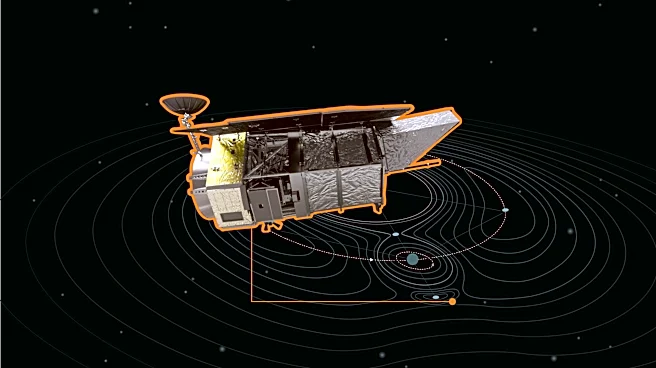
New observations from NASA’s James Webb Space Telescope (JWST) indicate that the processes stripping gas from planet-forming disks around young, Sun-like stars evolve as these systems mature. This research, led by Naman Bajaj of the University of Arizona
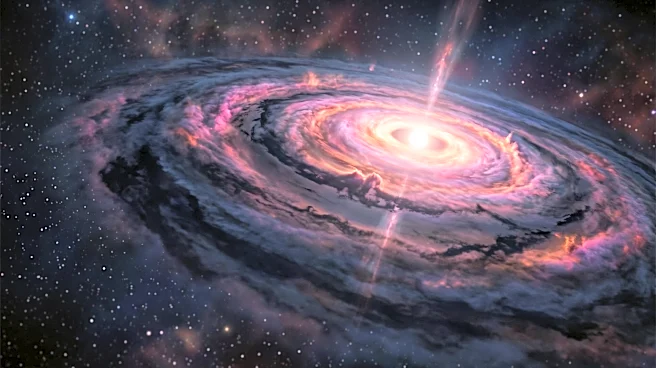
and coauthored by SETI Institute scientist Uma Gorti, examined protoplanetary disks around 72 young stars. The study, one of the largest JWST investigations into planet formation, reveals that different mechanisms dominate gas removal at various stages of disk evolution. In younger systems, strong jets and broad outflows containing molecular and atomic gas, consistent with magnetically powered winds, are prevalent. As systems age and less material falls onto the central star, these jets weaken. High-energy radiation from the young star then penetrates deeper into the disk, heating and expelling gas through a process known as photoevaporation, which becomes increasingly significant.
Why It's Important?
This discovery is crucial for understanding the formation of giant planets like Jupiter and Saturn. The rapid disappearance of gas from protoplanetary disks sets a fundamental time limit for the accumulation of massive atmospheres by these planets. If the gas dissipates too quickly, giant planets may not have sufficient time to form. The changing balance between magnetically driven winds and photoevaporation dictates how long gas remains available for planetary growth. This research provides direct observational evidence supporting earlier theoretical predictions about the evolution of disk winds, particularly the role of molecular hydrogen and X-ray photons. By clarifying the timeline and mechanisms of gas dispersal, scientists can better predict where and when different types of planets are likely to form, impacting our understanding of exoplanetary systems and the conditions necessary for habitability.
What's Next?
Researchers plan to quantify the amount of gas removed by these evolving winds over time and identify the specific regions of the disk from which the material escapes. These measurements will be vital for refining models of planet formation, providing a clearer picture of how quickly the window for giant planet formation closes. This will also help determine the optimal locations within a protoplanetary disk for different types of planets to form before the necessary gas is depleted. The continued use of JWST's advanced capabilities will be essential for gathering more detailed data on these processes, potentially leading to a more comprehensive understanding of planetary system development and the prevalence of gas giants in the universe.
Beyond the Headlines
The findings from JWST offer a deeper insight into the cosmic 'race against time' that giant planets face during their formation. This concept highlights the delicate balance of forces and the transient nature of the conditions required for the emergence of large, gas-rich worlds. The transition from magnetically driven winds to photoevaporation as the dominant gas removal mechanism illustrates the dynamic and complex evolution of young stellar systems. This research not only advances our knowledge of planet formation but also contributes to the broader quest to understand the diversity of planetary systems beyond our own. By understanding these fundamental processes, scientists can better assess the likelihood of finding other habitable worlds and the conditions that might support life elsewhere in the cosmos.