



What's Happening?
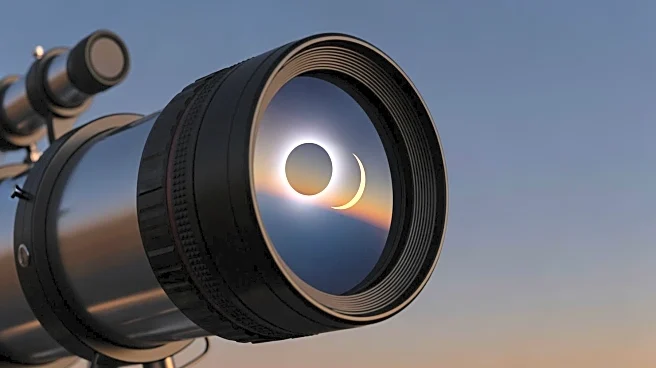
From 2026 to 2028, Earth will witness a series of double solar eclipses, including three total solar eclipses and three annular solar eclipses. This sequence, last observed from 2008 to 2010, begins with a total solar eclipse on August 12, 2026, visible
from Europe for the first time since 2015. The path will cross Siberia, Greenland, Iceland, and Spain. The 'eclipse of the century' on August 2, 2027, will be visible from southern Spain, North Africa, and the Middle East, offering views from historical sites like Luxor, Egypt. Another total eclipse will occur on July 22, 2028, visible in Australia and New Zealand.
Why It's Important?
These solar eclipses present significant opportunities for scientific observation and public engagement. They offer a chance for researchers to study the solar corona and other phenomena under unique conditions. For the public, these events provide rare opportunities to witness celestial events that can inspire interest in astronomy and science. Economically, regions within the eclipse paths may experience increased tourism, benefiting local businesses and communities. The eclipses also highlight the importance of international collaboration in scientific research and public education, as they span multiple continents and cultures.
What's Next?
As the dates approach, preparations for viewing and studying these eclipses will intensify. Governments and scientific organizations may organize public viewing events and educational programs to maximize public engagement. Researchers will likely plan expeditions to optimal viewing locations to conduct studies. The tourism industry in affected regions may also prepare for an influx of visitors, offering special tours and accommodations. These events will serve as a reminder of the need for continued investment in space science and education.