





What's Happening?
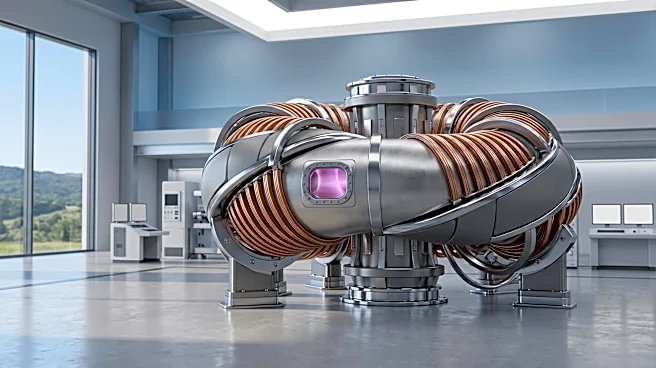
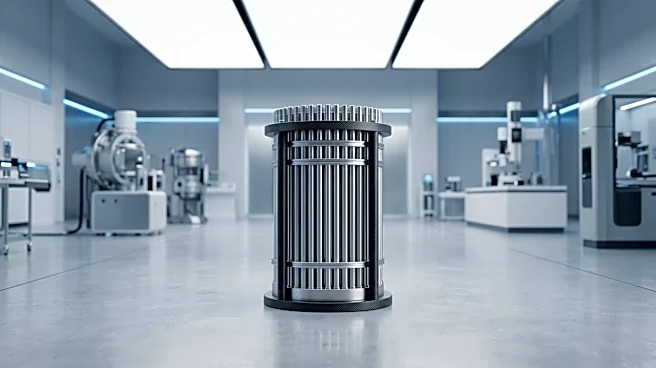
Westinghouse's eVinci microreactor has successfully completed zero-power criticality testing at the National Criticality Experiments Research Center within the Nevada National Security Site. This milestone, achieved on August 24, involved a one-fifth-scale
core designed to cool itself without pumps or water, utilizing sealed tubes. The test confirmed that the reactor's chain reaction could sustain itself, a crucial step in nuclear reactor development, without generating significant heat or electricity. The purpose of this zero-power test was to validate the physics and engineering models against the actual metal components, ensuring the design behaves as simulated. This method allows for cost-effective verification of reactor designs before proceeding to full-power prototypes, minimizing radioactivity and enabling quick access to the test environment.
Why It's Important?
The successful zero-power criticality of the Westinghouse eVinci microreactor marks a significant advancement in next-generation nuclear power technology. This design, which operates without water or moving parts for cooling, offers potential benefits for various applications, including powering data centers, mining operations, and military bases. The ability to achieve a self-sustaining chain reaction at minimal power validates the core's fundamental physics and the accuracy of its simulation models. This is critical for de-risking future development and investment in microreactor technology. If proven viable at full scale, such reactors could provide decentralized, reliable, and low-carbon energy solutions, reducing reliance on traditional power grids and fossil fuels. The technology's passive cooling mechanism also enhances safety by minimizing the risk of loss-of-coolant accidents, a key concern in conventional nuclear designs.
What's Next?
Following the successful zero-power test in Nevada, a one-fifth-scale eVinci microreactor is slated for further testing at the Department of Energy's DOME test bed at Idaho National Laboratory. This next phase will involve fueled experiments, potentially up to 20 megawatts of heat, to assess the reactor's performance under more realistic operating conditions. The results from Idaho will be crucial in determining the commercial viability and widespread adoption of solid-core heat-pipe reactors. Westinghouse aims to develop a full-size 5-megawatt-electric machine with a 15-megawatt-thermal core, designed to operate for eight years or more before requiring refueling. The company's ability to meet these performance targets will dictate whether the eVinci microreactor transitions from a promising concept to a practical energy solution for various industries.
Beyond the Headlines
The development of microreactors like the eVinci could fundamentally alter the energy landscape, particularly in remote or energy-intensive sectors. Their compact size and self-contained nature make them suitable for deployment in areas where traditional grid infrastructure is impractical or vulnerable. The passive cooling design, which eliminates the need for pumps and water, addresses some of the most significant safety and operational challenges associated with conventional nuclear power. This innovation could lead to a more resilient and distributed energy system, enhancing national energy security. Furthermore, the use of such advanced nuclear technologies could play a pivotal role in achieving decarbonization goals by providing a consistent, emissions-free power source, thereby contributing to broader climate change mitigation efforts and fostering a new era of nuclear energy deployment.