



What's Happening?
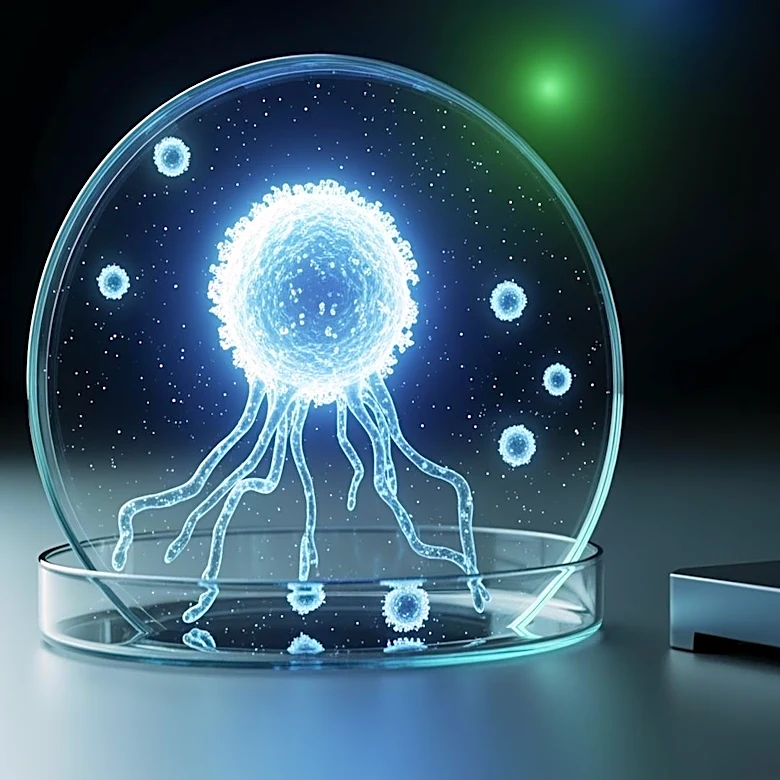
Researchers have identified a new microbe, Euplotes gigatrox, which displays a unique duality in behavior. Typically, this ciliate swims in seawater, consuming bacteria. However, under certain conditions, a cell within a colony can transform into a 'supergiant,'
significantly increasing in size and engaging in cannibalistic behavior by consuming its fellow cells. This transformation is akin to a Dr. Jekyll and Mr. Hyde scenario, where the microbe shifts from a benign state to a predatory one. The discovery was made by scientists at Rensselaer Polytechnic Institute, who cultured the organisms in artificial seawater. The supergiant cells grow to about 140 micrometers, compared to the normal 54 micrometers, and can consume other cells at a rate of one every 10 minutes. This behavior is triggered when the population reaches a stable phase after exponential growth, particularly when food sources become scarce.
Why It's Important?
The discovery of Euplotes gigatrox's behavior expands the understanding of single-celled organisms and their capabilities. It challenges existing perceptions of cellular behavior, showing that even simple organisms can exhibit complex survival strategies. This finding could have implications for studying cellular control mechanisms and evolutionary biology. The ability of these microbes to switch between feeding strategies based on environmental conditions highlights the adaptability of life forms, which could inform research in ecology and evolutionary biology. Additionally, understanding such mechanisms may provide insights into managing microbial populations in natural and artificial environments, potentially impacting fields like biotechnology and environmental science.
What's Next?
Future research will likely focus on understanding the genetic and environmental triggers that lead to the transformation of Euplotes gigatrox into supergiants. Scientists may explore the potential applications of this knowledge in biotechnology, such as developing new methods for controlling microbial populations. There is also interest in investigating whether similar behaviors exist in other microbial species, which could further broaden the understanding of microbial ecology and evolution. The study of these transformations could lead to new insights into the adaptability and resilience of life forms in changing environments.
Beyond the Headlines
The behavior of Euplotes gigatrox raises questions about the ethical implications of manipulating microbial life for research and industrial purposes. As scientists uncover more about the genetic controls of such transformations, there may be debates about the potential risks and benefits of applying this knowledge. Additionally, the discovery highlights the complexity of life at the microscopic level, challenging the notion that single-celled organisms are simple or primitive. This could lead to a reevaluation of how these organisms are perceived in both scientific and public discourse.