
What's Happening?
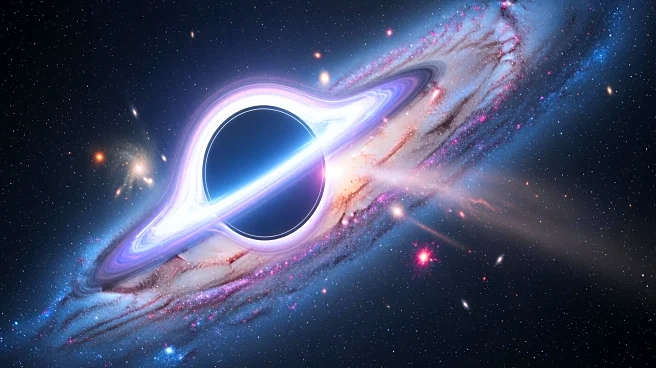
The James Webb Space Telescope (JWST) has potentially confirmed the existence of a runaway supermassive black hole, which is escaping its host galaxy at a speed of 2.2 million miles per hour. This discovery,
led by Pieter van Dokkum, a professor of astronomy and physics at Yale University, follows decades of theoretical research on such phenomena. The black hole, with a mass of 20 million suns, was initially identified in 2023 through archival images from the Hubble Space Telescope. Subsequent observations from the Keck Observatory in Hawaii and JWST have provided further evidence, including a 'wake' of young stars stretching 200,000 light-years, indicating the black hole's path. The JWST's advanced capabilities allowed researchers to observe a bow shock, a wave-like feature created by the black hole's rapid movement through space.
Why It's Important?
This discovery is significant as it provides new insights into the dynamics of galaxies and the behavior of supermassive black holes. Understanding runaway black holes can help scientists learn more about the evolution of galaxies and the conditions that allow such massive objects to escape their gravitational confines. The study of these phenomena could also shed light on the interactions between multiple black holes and the potential for such interactions to result in one being ejected from its galaxy. This research could influence future astronomical studies and the development of theoretical models regarding galaxy formation and black hole dynamics.
What's Next?
The research team plans to search for more examples of runaway supermassive black holes to further understand their characteristics and origins. The study mentions several promising candidates, including an object known as the 'Cosmic Owl,' which features two galactic nuclei and a third black hole embedded in a gas cloud. Future observations and analyses will aim to clarify the nature of these systems and the processes that lead to the formation and ejection of supermassive black holes. Continued advancements in telescope technology and observational techniques will be crucial in these efforts.