



What's Happening?
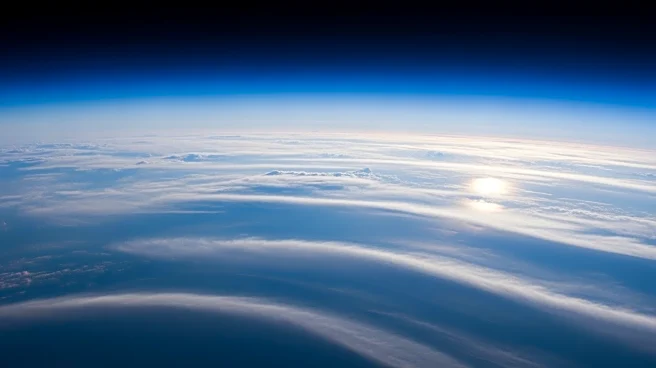
In September 2024, the International Space Station (ISS) observed atmospheric gravity waves above Florida, linked to Hurricane Helene. These waves, detected by NASA's Atmospheric Waves Experiment (AWE), were seen in the mesosphere, about 88 kilometers
above Earth. The AWE instrument, installed on the ISS in November 2023, captured images of ripple-like disturbances in the airglow, a faint light emission from atmospheric gases. This discovery highlights the connection between surface weather events and upper atmospheric conditions, providing valuable data for understanding space weather and its impact on satellite operations.
Why It's Important?
The detection of gravity waves by the ISS is significant for several reasons. It enhances the understanding of how terrestrial weather affects the upper atmosphere, which is crucial for satellite safety and performance. Gravity waves can alter air density, impacting satellite drag and orbital paths. This data is vital for aerospace engineers and satellite operators to anticipate and mitigate potential disruptions in communication and navigation systems. Additionally, the findings contribute to broader space weather studies, particularly in understanding interactions between Earth's atmosphere and charged particles in the ionosphere and magnetosphere.
What's Next?
The AWE mission will continue to monitor atmospheric conditions, providing ongoing data to improve models of atmospheric dynamics. This research could lead to better predictions of space weather events and their effects on satellite operations. The insights gained may also inform future satellite design and deployment strategies, enhancing resilience in space infrastructure. As the AWE instrument continues to operate, it will contribute to a deeper understanding of the mesosphere, a region that has been challenging to study due to its altitude.