





What's Happening?
Dr. Logan Miller, a professor of anthropology at Illinois State University, has assisted in identifying the burial site of David A. Strother, the first Black man to vote in Illinois. Strother cast his ballot in 1870 after the passage of the 15th Amendment.
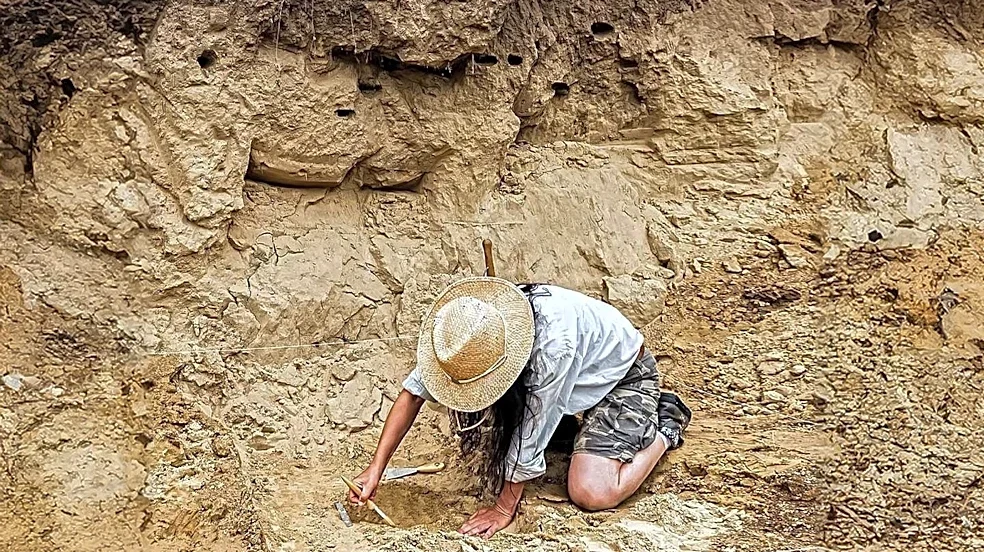
The Project XV Museum, a nonprofit established in 2021 at Strother's former barbershop in El Paso, Illinois, honors his legacy and the history of voting rights for marginalized groups. While newspaper records indicated Strother, his mother Leah, wife Elizabeth, and brother Charles were buried in Evergreen Cemetery, their exact locations were unknown. Barb Lancaster, a Project XV board member, contacted Dr. Miller for expert assistance. Using ground-penetrating radar (GPR), Miller identified four distinct anomalies in the ground near Strother's commemorative stone, strongly suggesting the burial locations of the family. This discovery provides a tangible piece of evidence to Strother's story and the broader history of voting rights.
Why It's Important?
This identification is significant for several reasons. It provides a definitive location for the resting place of a pivotal figure in Illinois's civil rights history, offering a concrete connection to the past. David A. Strother's act of voting in 1870, despite being questioned by election judges, represents a crucial moment in the struggle for Black suffrage in the United States. The Project XV Museum's efforts, now bolstered by this discovery, can further educate the public about the historical challenges faced by marginalized communities in exercising their right to vote. This work underscores the ongoing importance of historical preservation and archaeological methods in uncovering and validating narratives that contribute to a more complete understanding of American history. The confirmation of the burial site also allows for proper memorialization of Strother's family, further honoring their place in history.
What's Next?
Following the identification of the burial sites, the Project XV board is now actively raising funds to place headstones for Strother's mother, wife, and brother. In a remarkable turn of events, Barb Lancaster discovered that Pontiac Granite, the company that placed Strother's original marker in 1954, still possesses three pieces of stone from the same quarry, which has since closed. This provides the exact material needed for the new markers, adding a unique historical continuity to the project. The Project XV Museum will continue its mission of educating the public on voting rights history, with the newly confirmed burial site serving as an important historical landmark. The museum, located at 1 Front Street in El Paso, remains open to the public, offering private tours to further engage visitors with Strother's story and the broader context of voting rights.
Beyond the Headlines
The identification of David A. Strother's family burial site extends beyond a simple archaeological find; it reinforces the enduring relevance of historical figures in contemporary discussions about civil rights and democratic participation. Strother's courage in exercising his right to vote in the post-Civil War era serves as a powerful reminder of the struggles faced to secure fundamental rights. This discovery can inspire deeper engagement with the history of the 15th Amendment and its impact on African American communities. Furthermore, the collaboration between academic institutions like Illinois State University and local historical societies, such as the Project XV Museum, highlights the critical role of interdisciplinary efforts in preserving and interpreting history. It underscores how scientific methods, like GPR, can bring clarity to historical mysteries, making the past more tangible and accessible for future generations, thereby strengthening the narrative of American democracy and its ongoing evolution.