






What's Happening?
The Midpeninsula Regional Open Space District (Midpen) is proposing a plan to cut down trees in the La Honda Forest as part of the La Honda Forest Health Project. This initiative aims to restore the health of densely forested areas within the La Honda Creek
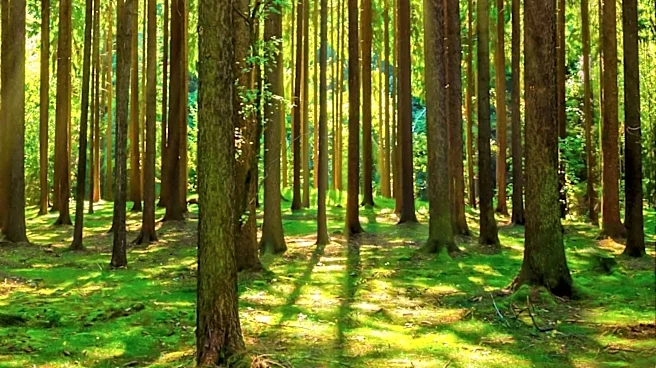
Open Preserve, which have been negatively impacted by logging in the 1800s. Leigh Ann Gessner, a public affairs specialist at Midpen, explained that the forest is currently overcrowded with second- and third-growth trees, preventing sunlight from reaching the forest floor and leading to a lack of plant and wildlife diversity. The project involves implementing restoration forestry techniques, including selectively thinning dense areas, to guide the forest back towards healthier, old-growth conditions. A Timber Harvesting Plan, which requires review by Cal Fire and a public review process, is necessary before the restoration can begin. The project's goals include improving forest health, watershed health, wildlife habitat, carbon storage, and increasing resilience to fire, disease, and climate change.
Why It's Important?
This project is significant because it addresses the long-term ecological consequences of historical logging practices and highlights the importance of active forest management. The current dense growth in the La Honda Forest creates an unhealthy ecosystem, making it vulnerable to wildfires, disease, and reduced biodiversity. By thinning these areas, Midpen aims to restore a more natural forest structure, allowing for greater light penetration, which in turn supports a more diverse understory and wildlife habitat. This initiative also contributes to climate change mitigation by enhancing the forest's capacity for carbon storage and increasing its resilience to environmental stressors. The public review process for the Timber Harvesting Plan ensures transparency and community involvement in decisions that affect local natural resources, underscoring the balance between conservation and public engagement.
What's Next?
A study session was held on November 10 to provide an update on the La Honda Forest Health Project and discuss the Timber Harvesting Plan. Following this, the plan will undergo review by Cal Fire and a public review process, similar to an Environmental Impact Report. If the Timber Harvesting Plan receives approval from Cal Fire, Midpen anticipates initiating its forest treatment processes between 2027 and 2028. During this period, Midpen will continue to engage with the public and stakeholders, providing opportunities for input and addressing any concerns. The project's success will depend on careful implementation and ongoing monitoring to ensure that the restoration efforts achieve their intended ecological benefits.
Beyond the Headlines
The La Honda Forest Health Project illustrates a critical shift in environmental management towards proactive restoration rather than passive preservation. It acknowledges that past human activities have altered ecosystems to such an extent that active intervention is necessary to restore ecological balance. The project's focus on creating a diverse, resilient forest with varying tree sizes and decaying wood on the forest floor reflects a modern understanding of healthy forest ecosystems. Furthermore, the potential sale of timber from removed trees, with funds reinvested into the restoration project, demonstrates a sustainable economic model for conservation. This approach not only addresses immediate ecological concerns but also aims to build long-term resilience against future environmental challenges, such as climate change and increased wildfire risk.