






What's Happening?
George Mason University recently held its first Grand Challenge Initiative (GCI) Exchange Day, bringing together over 200 faculty members to discuss ongoing GCI-related work and foster collaboration. The event, hosted by the Office of Research, Innovation,
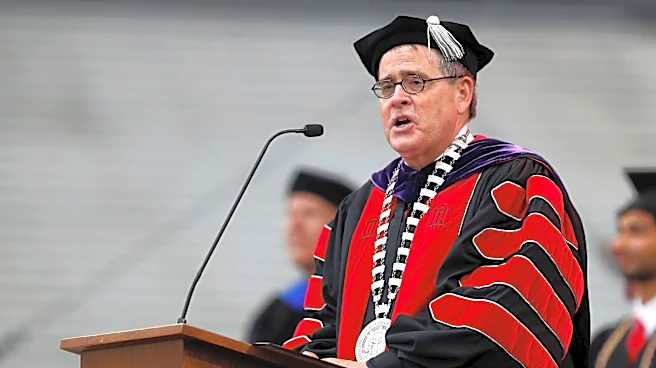
and Economic Impact (ORIEI) and interim vice president Aurali Dade, marked the launch of the second year of GCI funding. George Mason launched GCI in 2025 with a five-year, $15 million investment to align university resources and expertise around six interconnected solutions aimed at securing a peaceful, healthy, and prosperous future. The initiative has already awarded funding to two large and five small catalyst projects in its first year. President Gregory Washington emphasized that GCI is transforming George Mason into a unified research engine capable of competing at the highest levels and positioning the university for long-term competitiveness by focusing on areas of national priority. The event included a fireside chat with George Mason alumnus Sumeet Shrivastava, rector of the Board of Visitors, and a panel discussion with associate deans of research from four colleges.
Why It's Important?
The Grand Challenge Initiative is a significant strategic investment by George Mason University to enhance its research capabilities and national standing. By fostering interdisciplinary collaboration and focusing on critical global challenges, the university aims to become a 'partner of choice' for government agencies, industry, and non-governmental organizations. This initiative not only strengthens George Mason's research infrastructure but also positions it to attract substantial external funding and talent. The emphasis on 'national priority' areas suggests a direct alignment with federal research agendas, potentially leading to increased grants and partnerships. For faculty, the GCI provides opportunities for seed funding and collaboration, encouraging innovative research that addresses complex societal issues. The long-term vision is to establish George Mason as a leader in integrated, cross-sector expertise, setting a precedent for how universities can effectively tackle grand challenges.
What's Next?
The second year of GCI funding has officially launched, with a call for research proposals. Research teams are expected to submit a Letter of Intent to their lead school/college dean’s office by December 4, 2026. Final proposals are due by February 15, 2027, at 11:59 p.m., with award decisions anticipated by April 30, 2027. The university plans to award up to two large catalyst grants, each up to $750,000 for up to 36 months, and up to five small catalyst grants, each up to $100,000 for 18 months. Additionally, a networking event for faculty interested in collaborating on GCI-related research will be held to further facilitate interdisciplinary partnerships. These steps indicate a continued commitment to expanding the initiative's reach and impact, with a clear timeline for future funding and project development.
Beyond the Headlines
The Grand Challenge Initiative represents a broader trend in higher education towards mission-driven research that addresses complex, real-world problems. By explicitly aligning university resources with 'humanity’s ultimate grand challenge,' George Mason is not only pursuing academic excellence but also aiming to demonstrate tangible societal impact. This approach could influence how other universities structure their research programs, moving away from siloed disciplines towards integrated, collaborative models. The initiative's focus on 'national priority' areas also highlights the increasing expectation for academic institutions to contribute directly to national strategic goals. Furthermore, the emphasis on cross-campus infrastructure and faculty talent development suggests a long-term institutional transformation, aiming to cultivate a culture of innovation and interdisciplinary problem-solving that extends beyond the initial five-year investment.