
What's Happening?
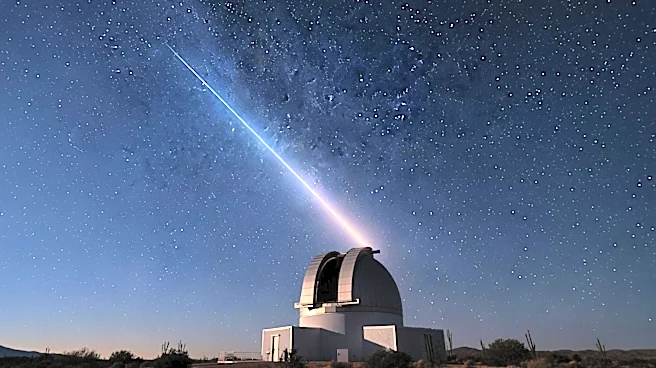
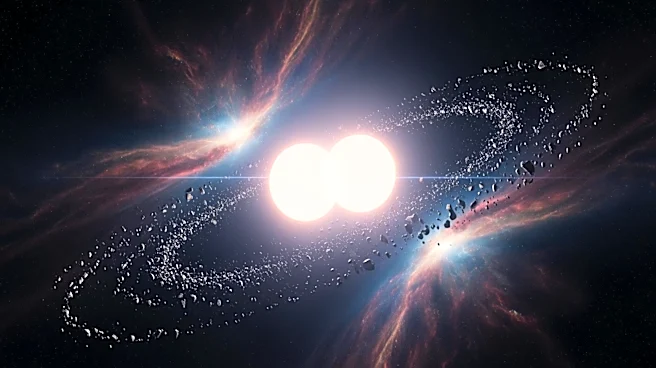
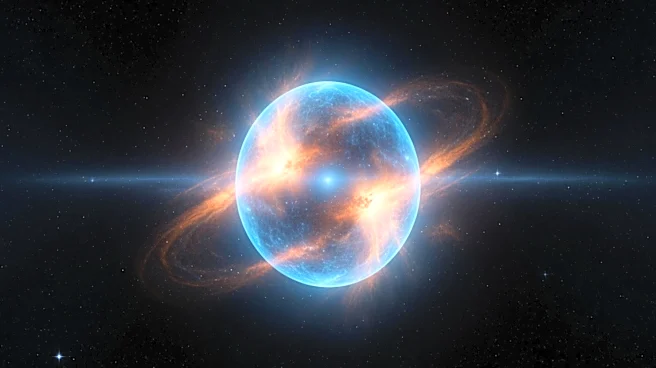
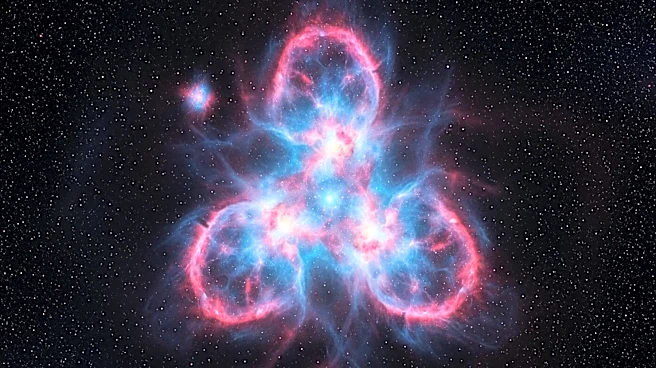
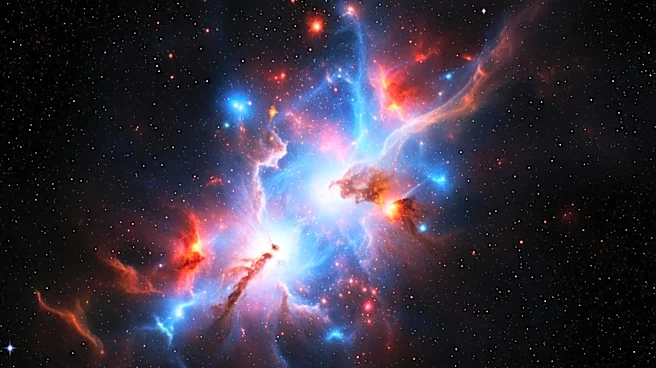
A new image of the Crystal Ball Nebula, captured by the Gemini North telescope in Hawaii, reveals the intricate details of a dying star in a binary system located 1,500 light-years away in the Taurus constellation. The image, taken by the National Science
Foundation’s National Optical-Infrared Astronomy Research Laboratory (NOIRLab), shows one star shedding its outer layers while its companion star churns the expanding gas into cloudlike shapes. This celestial phenomenon, known as a planetary nebula, occurs when a star ejects its outer layers, leaving behind a white dwarf surrounded by a region of dust and gas. The nebula's vivid colors are due to a filter in the spectrograph that highlights specific wavelengths of light, corresponding to gases like hydrogen and oxygen.
Why It's Important?
The image of the Crystal Ball Nebula provides valuable insights into the life cycle of stars, particularly in binary systems where one star reaches the end of its life before the other. Understanding these processes helps astronomers learn about the formation and evolution of planetary nebulae, which are crucial for studying the chemical enrichment of the galaxy. The nebula's complex shapes and colors, influenced by the interaction between the two stars, offer a unique opportunity to observe the effects of stellar death on surrounding space. This research contributes to a broader understanding of cosmic phenomena and the dynamic processes that shape our universe.
What's Next?
Scientists will continue to monitor the Crystal Ball Nebula to observe changes in the temperature of the central star and the expansion of the nebula's material. As technology advances, telescopes will capture even more detailed images, allowing researchers to study the nebula's evolution over time. This ongoing observation will provide further insights into the mass loss of dying stars and the impact on their surrounding environments. The study of planetary nebulae remains a dynamic field, with each new image offering fresh perspectives on the life cycles of stars.
Beyond the Headlines
The Crystal Ball Nebula's observation highlights the importance of multi-wavelength studies in astronomy. Different telescopes, like the James Webb Space Telescope, can reveal varying aspects of the same object, offering a more comprehensive understanding of its structure and composition. This approach underscores the need for diverse observational techniques to fully appreciate the complexity of celestial phenomena. Additionally, the nebula's study serves as a reminder of the transient nature of cosmic events, emphasizing the importance of capturing these moments to enhance our knowledge of the universe.