



What's Happening?
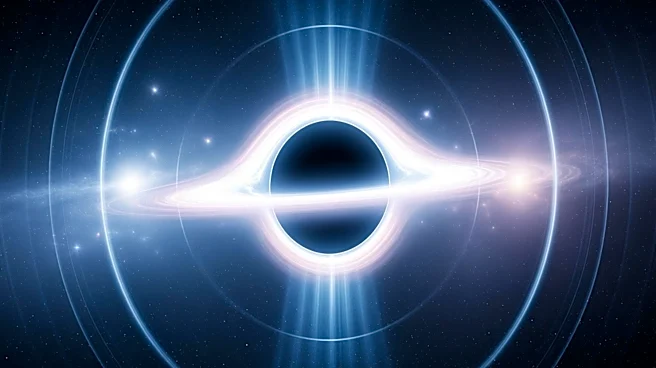
Recent data from the LIGO, Virgo, and KAGRA collaboration has provided a precise measurement of a theoretical boundary in stellar evolution, identifying a lower edge of 44.3 solar masses as the limit for stars likely to collapse directly into black holes.
This finding suggests that stars below this mass are more prone to such collapses, while more massive stars are less likely to follow this path. The research also extracted a 268 keV S-factor for the 12C(α, γ)16O nuclear reaction rate, linking gravitational-wave astronomy with nuclear astrophysics. The data revealed two distinct populations of black holes: a low-spin group with no black holes above the gap, and a high-spin, isotropic group that spans the full mass range, consistent with hierarchical mergers in dense stellar clusters.
Why It's Important?
This discovery is significant as it refines our understanding of stellar evolution and black hole formation. By pinpointing the lower edge of the pair-instability mass gap, researchers can better predict which stars will collapse into black holes. This has implications for astrophysics, as it challenges previous models and provides a more nuanced understanding of black hole growth. The ability to extract nuclear reaction rates from gravitational wave data also represents a novel intersection of different scientific fields, potentially leading to new insights into the processes powering stars.
What's Next?
Future research will likely focus on further analyzing gravitational wave data to refine these findings and explore the implications for stellar evolution models. The identification of distinct black hole populations suggests that additional studies could provide more detailed insights into the dynamics of black hole mergers and the environments in which they occur. This could lead to a deeper understanding of the lifecycle of massive stars and the role of hierarchical mergers in black hole growth.