



What's Happening?
Researchers from Deutsches Elektronen-Synchrotron DESY, the Italian National Institute of Nuclear Physics, the University of Sydney, and the University of Padua have conducted a study to explore the potential existence of a fifth fundamental force in
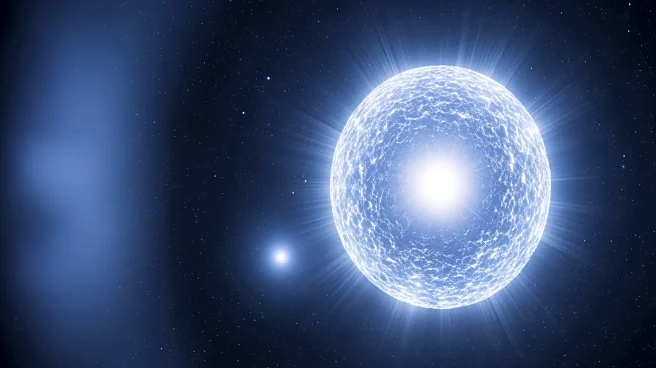
physics. This study focuses on neutron stars, which are ultra-dense remnants of stars primarily composed of nucleons. The researchers investigated whether hypothetical scalar particles, which could violate known gravitational laws, might accelerate the cooling process of these stars. By comparing theoretical predictions with simulations of neutron star cooling, the study set the strictest limits to date on the strength of scalar-nucleon interactions. The findings suggest that if a fifth force exists, it must be significantly weaker than previously thought, as the observed cooling of neutron stars aligns with current gravitational theories.
Why It's Important?
The potential discovery of a fifth force could revolutionize the field of physics, offering new insights into the fundamental forces that govern the universe. Such a force might be mediated by scalar particles, which are predicted in various extensions of the Standard Model of particle physics. These particles could also be linked to dark matter and extra dimensions, providing a deeper understanding of the universe's composition. The study's findings, which place stringent constraints on the existence of a fifth force, could guide future research and experiments aimed at uncovering new physical phenomena. This research underscores the importance of neutron stars as natural laboratories for testing fundamental physics theories.
What's Next?
The researchers plan to continue probing the existence of a fifth force using new astronomical data. Future observations of neutron stars could reveal previously unknown phenomena, potentially leading to breakthroughs in understanding the universe's most enigmatic mysteries. The study's results will inform ongoing and future experiments in particle physics and astrophysics, as scientists seek to refine theories that predict deviations from known gravitational laws. As new data becomes available, researchers hope to further explore the role of scalar particles and their potential interactions with nucleons in neutron stars.
![Daily Slop: 12 Feb 26 – New Commanders OC David Blough: “How do we get Terry [McLaurin] 10 targets a game?“](https://glance-mob.glance-cdn.com/public/cardpress/binge-magazine-card-generation/spaces/US/en/sb-nation/images/ppid_2cf3d240-image-177091266842313096.webp)