






What's Happening?
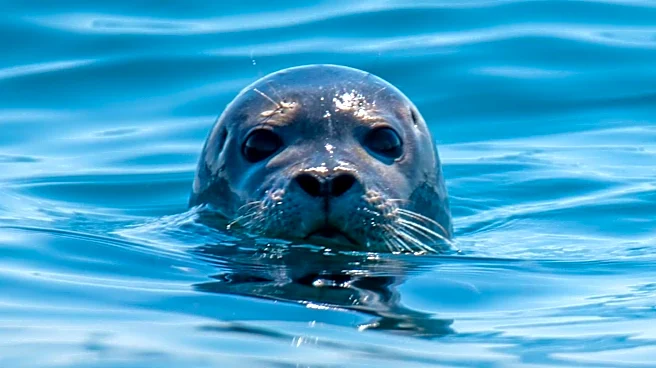
Professor of Biology Krista Ingram at Colgate University has developed AI-based facial recognition technology to study the social networks of harbor seals. This innovative approach addresses the challenge of tracking elusive marine animals, which traditionally
relied on invasive mark-recapture methods. The AI technology allows researchers to identify individual seals by their unique facial features, even though their bodies change due to molting. By analyzing when and where seals are together, Ingram's team can construct social networks, providing crucial insights into their population dynamics. This research has been ongoing for seven years and represents a significant advancement in non-invasive wildlife study.
Why It's Important?
This AI-based research holds significant implications for marine conservation and environmental management in the U.S. Harbor seals are difficult to observe, making it challenging for groups like the military to identify areas to avoid during operations. Ingram's technology provides a non-invasive method to understand seal movements and social structures, enabling better-informed decisions to mitigate environmental impact. Smaller organizations, including nonprofits, are also benefiting by using these tools for citizen science initiatives, such as tracking stranded marine animals. Public participation in collecting photographs and data, combined with AI analysis, can reveal patterns in stranding occurrences and social networks, contributing to more effective conservation efforts and public awareness.
What's Next?
The future application of this AI technology is expected to expand beyond harbor seals to other marine species that are difficult to track. The military and other marine research groups will likely integrate these findings and tools into their environmental assessment protocols to minimize disturbances to marine life. Nonprofits and citizen science programs will continue to leverage this technology to gather and analyze data on marine animal strandings, fostering greater public engagement in conservation. Further development may focus on refining the AI algorithms for even greater accuracy and efficiency, potentially leading to real-time tracking capabilities and more dynamic insights into marine animal behavior and population health. This could also lead to the development of standardized protocols for using AI in wildlife research.
Beyond the Headlines
The development of AI for animal facial recognition opens up broader ethical and scientific discussions. While the immediate benefit is non-invasive research, the increasing sophistication of AI in identifying individual animals could lead to new considerations regarding wildlife management and human-animal interactions. This technology could also serve as a model for applying AI in other ecological studies, potentially revolutionizing how scientists monitor and protect endangered species globally. The success of this project highlights the potential of interdisciplinary research, combining biology with advanced computing, to solve complex environmental challenges. It also underscores the growing role of citizen science in contributing valuable data to scientific endeavors, empowering the public to participate directly in conservation efforts.