





What's Happening?
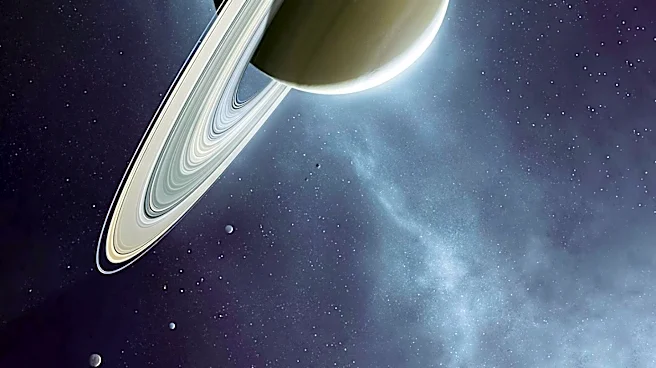
Scientists have identified a massive 10-sided wave pattern, described as a decagon, swirling within the icy ammonia clouds above Saturn’s south pole. This discovery was made using the Hubble Space Telescope in 2023. The Spanish-led research team reported
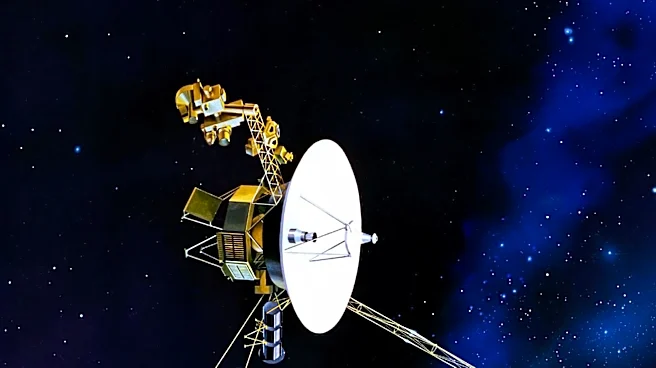
that this spinning, meandering decagon appears to be larger and more unstable than the well-known hexagonal cloud formation observed around Saturn’s north pole by NASA’s Voyager probes in the 1980s. Researchers suspect this atmospheric phenomenon developed between 2017 and 2023, a period when Saturn’s south pole was not visible from Earth. The decagon is still evolving, with one side already measuring over 10,000 miles (16,700 kilometers). The findings were published in the journal Science Advances, highlighting that while all planets with atmospheres exhibit wave-spawning disturbances, only Saturn produces them in polygonal shapes. Unlike the stationary hexagon, the decagon migrates eastward at approximately 6 mph (10 kph).
Why It's Important?
The discovery of the decagon is significant because it challenges the previous understanding of Saturn's atmospheric dynamics, suggesting that the hexagon at the north pole is not as unique as once thought. This new formation provides scientists with an unprecedented opportunity to compare two distinct polygonal jet stream formations on opposite ends of the same planet. By studying these structures, researchers can gain deeper insights into the complex weather patterns and atmospheric behaviors of giant gas planets. Understanding how these unique polygonal shapes form and evolve on Saturn can contribute to a broader comprehension of planetary atmospheric science, potentially revealing universal principles governing fluid dynamics in extreme environments. The University of Leicester’s Leigh Fletcher, who measured the decagon's wind using the European Southern Observatory’s Very Large Telescope, emphasized that 'Saturn still has the ability to surprise us,' underscoring the ongoing importance of space observation and research.
What's Next?
Astronomers anticipate that improved views of Saturn’s southern hemisphere over the coming years will enable them to capture more detailed observations of the decagon. This increased visibility is expected to help solve what lead author Agustin Sanchez-Lavega described as an 'intriguing atmospheric mystery.' Researchers will continue to monitor the decagon to determine if it will persist as long as the hexagon, which has been visible for over 40 Earth years, exceeding a full Saturnian year (equivalent to 30 Earth years). Sanchez-Lavega confirmed that the decagon is currently still present. Future observations will aim to understand the decagon's long-term stability, its interaction with other atmospheric phenomena, and whether it might be related to the polygonal cyclone arrangements observed on Jupiter. These ongoing studies will be crucial for refining models of planetary atmospheres and fluid dynamics.
Beyond the Headlines
The existence of a second polygonal storm on Saturn, particularly one that is larger and more dynamic than the well-known hexagon, opens up profound questions about the fundamental physics governing planetary atmospheres. The fact that only Saturn produces these geometric shapes, despite other planets having atmospheric disturbances, suggests unique conditions or processes at play. This discovery could lead to a re-evaluation of current atmospheric models and potentially uncover new principles of fluid mechanics under extreme conditions. The comparison between the stationary hexagon and the migrating decagon offers a natural laboratory to study the factors influencing the stability and movement of such large-scale atmospheric features. This research not only enhances our understanding of Saturn but also provides a comparative framework for studying exoplanets, where direct observation of atmospheric dynamics is often limited. The ongoing surprises from Saturn underscore the vast unknowns in our solar system and the continuous need for space exploration and scientific inquiry.