



What's Happening?
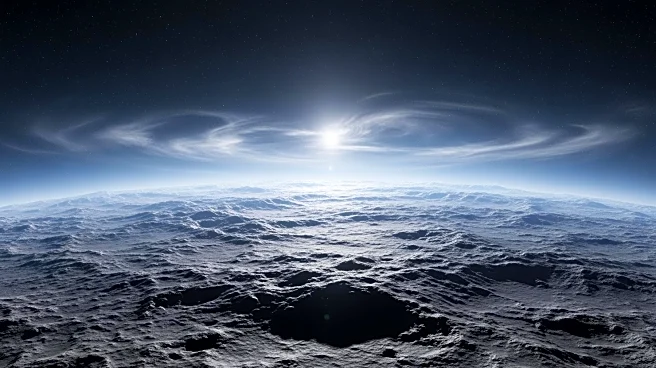
The James Webb Space Telescope (JWST) has provided new insights into the exoplanet TOI-561 b, previously thought to be a barren rock. Observations using JWST's Near-Infrared Spectrograph (NIRSpec) revealed that the planet, which orbits its star much closer
than Mercury does to the Sun, has a volatile-rich atmosphere. This atmosphere, possibly composed of water vapor, oxygen, and carbon dioxide, suggests the presence of a global magma ocean. The planet's dayside temperature was measured at about 1,800 degrees Celsius, cooler than expected for a planet without an atmosphere.
Why It's Important?
The discovery of an atmosphere on TOI-561 b challenges previous assumptions about the planet's composition and raises questions about atmospheric retention under extreme conditions. This finding is crucial for understanding planetary formation and evolution, particularly in harsh environments. The presence of a magma ocean and a volatile-rich atmosphere suggests complex interactions between the planet's surface and atmosphere, offering a unique opportunity to study such dynamics. This research could inform future studies on exoplanets and the potential for atmospheric retention in similar conditions.
What's Next?
Further observations and studies are likely to focus on understanding the chemical composition and dynamics of TOI-561 b's atmosphere. Researchers may explore the implications of the planet's volatile-rich atmosphere for its formation history and potential habitability. The findings could also influence the search for other exoplanets with similar characteristics, expanding our knowledge of planetary systems beyond our own. Continued use of JWST and other advanced telescopes will be essential in uncovering more about this intriguing exoplanet.