





What's Happening?
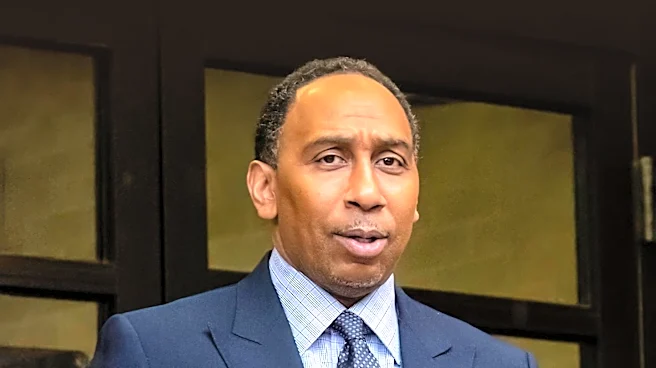
Stephen A. Smith, a prominent sports commentator and media personality, received the National Association of Black Journalists (NABJ) 'Thumbs Down' award during its annual convention in Atlanta. The award is given to individuals or institutions deemed
to have engaged in insensitive or stereotypical commentary. NABJ specifically cited Smith's 'repeated pattern of criticizing prominent Black women in ways that undermine fair representation' across sports, politics, and media. While the organization did not provide specific examples in its announcement, a recent controversy involving U.S. Rep. Jasmine Crockett of Texas was highlighted as context. Smith had previously criticized Crockett's confrontational political style, using language that some perceived as dismissive and leading to accusations of 'tone policing' a Black woman in politics. Smith later apologized to Crockett, acknowledging that his words could be used against her by political opponents, but maintained his right to critique public officials. Smith has publicly responded to the award, promising a fuller response and suggesting he has grievances of his own against NABJ.
Why It's Important?
This award and the ensuing controversy signify a significant rift between a highly influential Black media figure and a leading organization dedicated to supporting Black journalists. NABJ's decision to publicly rebuke Smith underscores its commitment to challenging narratives that it believes are harmful to Black women in public life. The incident with Rep. Jasmine Crockett serves as a critical example, illustrating how commentary, even from within the Black community, can be perceived as undermining or stereotypical. Smith's prior apology to Crockett complicates his current stance, as it indicates a previous acknowledgment of the impact of his words. The dispute highlights the ongoing debate within media and public discourse about accountability, representation, and the appropriate boundaries of criticism, particularly when directed at marginalized groups. This event could influence how media personalities approach commentary on sensitive topics and how organizations like NABJ continue to advocate for fair representation.
What's Next?
Stephen A. Smith has indicated he will issue a comprehensive public response to the NABJ award, suggesting that the dispute is far from over. His statement, 'Now y’all started something,' implies a readiness to air his own grievances and challenge NABJ's assessment. This response could take various forms, including through his podcast, SiriusXM show, or other public platforms. The unfolding situation will likely continue to generate significant discussion within sports media, political circles, and among those concerned with media ethics and representation. Both Smith and NABJ have reputations for direct communication, making a quiet resolution unlikely. The outcome of this public exchange could set precedents for how prominent media figures engage with criticism from professional organizations and how these organizations hold their members and the broader media landscape accountable for their commentary.
Beyond the Headlines
The 'Thumbs Down' award and Stephen A. Smith's reaction delve into deeper issues concerning the role of Black media figures in public discourse and the internal dynamics of accountability within the Black community. It raises questions about who has the authority to define 'harmful narratives' and 'fair representation,' and how criticism should be delivered and received, especially when it involves intra-community dialogue. The controversy also touches upon the evolving nature of media influence, as Smith's expanding platform beyond sports into politics and culture brings increased scrutiny. This incident could prompt a broader conversation about the responsibilities of influential commentators, the impact of their words on public perception, and the challenges of navigating complex issues of race, gender, and power in the media landscape. It highlights the tension between an individual's right to free expression and the collective responsibility to foster respectful and equitable representation.