






What's Happening?
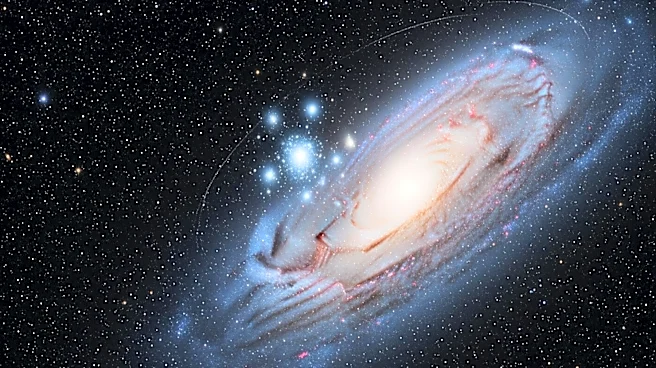
Astronomers have successfully mapped the hidden edge of the Milky Way, identifying where star formation activity fades. This boundary, located about 40,000 light-years from the galactic center, marks the outer limit of the galaxy's star-forming region.
The research, led by an international team, utilized observations of bright giant stars and advanced galaxy simulations to reveal a U-shaped pattern in stellar ages. This pattern indicates that star formation decreases sharply beyond this boundary, with older stars dominating the outermost regions due to a process called radial migration. This process involves stars moving outward over time by interacting with spiral waves in the galaxy.
Why It's Important?
Mapping the Milky Way's edge is a significant advancement in galactic archaeology, providing a clearer understanding of the galaxy's structure and star formation processes. The findings highlight the role of radial migration in shaping the distribution of stars, offering insights into how galaxies grow from the inside out. This research enhances our knowledge of the Milky Way's evolution and the factors influencing star formation, such as the central bar and outer warp. Understanding these dynamics is crucial for developing accurate models of galaxy formation and evolution, contributing to the broader field of astrophysics.
What's Next?
Future surveys, including 4MOST and WEAVE, will provide more detailed data to refine these findings and improve our understanding of the Milky Way's structure. Researchers will continue to investigate the factors influencing star formation and migration, such as the central bar and outer warp. This ongoing research will help astronomers develop more accurate models of the Milky Way and other similar galaxies, contributing to a deeper understanding of the universe's evolution. The study also underscores the importance of stellar ages as a tool for studying galaxy history, paving the way for new discoveries in galactic archaeology.